
Long Thick Hair — Best Haircuts, Styling & Care Guide
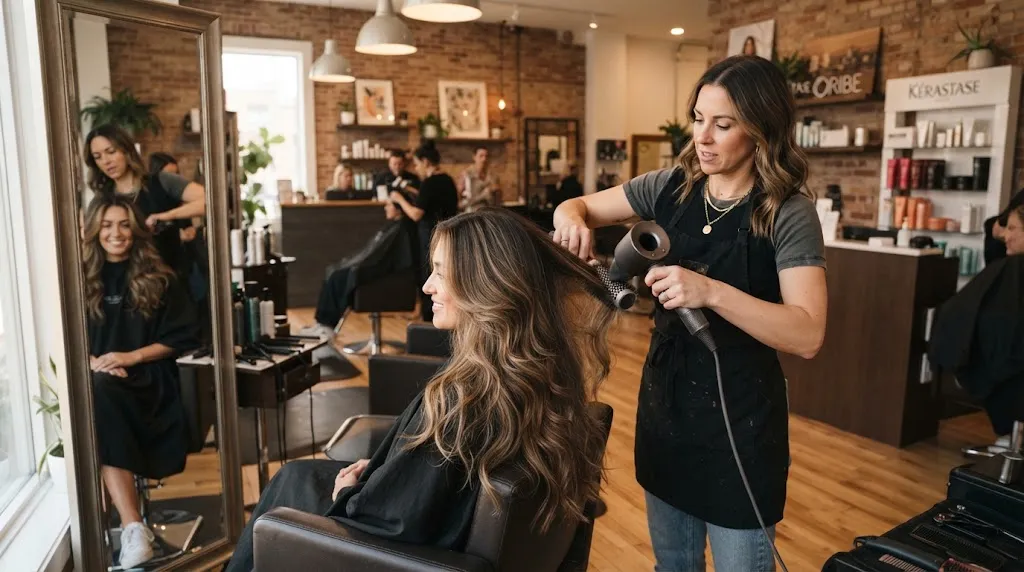
Best Haircuts for Long Thick Hair

The absolute best haircut styles for thick hair rely on interior weight-removal techniques and strategic layering to prevent a heavy, triangular silhouette, allowing dense strands to move naturally without losing fullness.
Best cuts: Long, fluid layers starting well below the collarbone combined with face-framing pieces to relieve bulk around the jawline.
Texturizing approach: Slide-cutting and point-cutting rather than blunt chopping to diffuse dense weight at the ends.
The #1 mistake: Cutting blunt, heavy lines straight across the perimeter, which creates an unwanted pyramid shape on dense textures.
The #1 maintenance rule: Regular weight-reduction trims every 8 to 12 weeks to keep the interior bulk from collapsing your natural wave pattern.
Next steps: If long thick hair isn’t your only concern, our full hairstyles collection at HairstylesUSA covers every hair type and length.
What Does "Thick Hair" Actually Mean? (Density vs. Diameter)
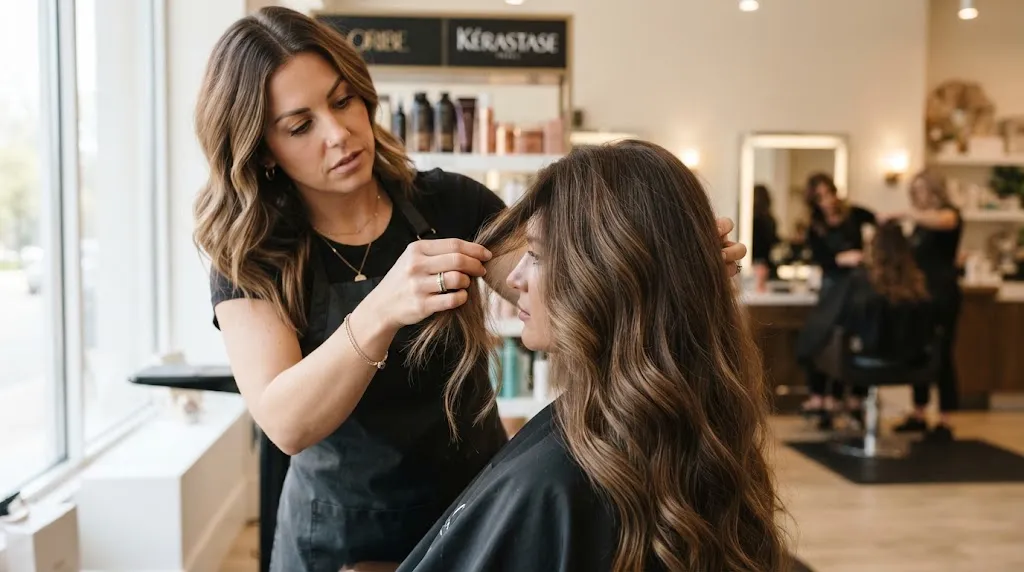
People constantly mix up having a lot of hair with having heavy, coarse hair, but in the salon chair, those are two entirely different things. Thick hair refers strictly to strand diameter—meaning each individual hair is physically wider and coarser compared to fine hair. You can have high strand diameter (thick individual strands) while actually having a relatively low overall amount of hair on your head.
To figure out what you are actually working with, try these two quick at-home diagnostic tests:
The Strand-Diameter Test: Take a single strand of shed hair from your brush and roll it between your fingertips. If you can barely feel it or it feels like a microscopic spider silk, your individual strands are fine. If you can clearly feel a distinct, rigid cylinder rolling between your fingers—almost like a piece of fine copper wire—you have thick hair.
The Scalp-Part Density Test: Look in the mirror and part your hair straight down the middle. If your scalp is blindingly obvious and wide-open all the way down, you have low density (even if your individual strands are thick). If your scalp is barely visible or completely hidden by a dense carpet of hair, you have high density.
When you sit down in my chair asking for long thick hair maintenance, knowing this distinction changes everything. A high-density head needs weight removal and internal thinning shears to prevent a triangle shape, while a high-diameter head just needs smoothing and moisture management to tame the natural coarse texture.
Best Haircuts for Long Thick Hair (By Texture)
Long Layers and V-Cut for Straight Thick Hair

Straight thick hair behaves like a heavy curtain because gravity pulls all that density straight down, which is why a combination of long layers and a sharp V-cut is a game-changer. By carving out internal weight and tapering the perimeter into a distinct “V” shape, you eliminate the dreaded triangular bulk while keeping maximum length intact. When you sit in my chair asking for this, say: “I want to remove heavy bottom weight with graduated long layers, but keep the perimeter pointed into a clean V.
Practical styling tip: Blow-dry your hair using a large round brush, pulling the layers back away from your face to help the V-cut shape swing naturally instead of sitting flat.
Long Shag, Butterfly Cut, and Curtain Bangs for Wavy Thick Hair

Wavy thick hair needs movement and localized debulking, which a long shag, a butterfly cut, or soft curtain bangs deliver by creating structured zones of lightness. These cuts utilize multi-tiered layers to let your natural wave pattern expand without getting bottom-heavy or overly wide at the jawline. Tell your stylist: “I need internal texturizing and face-framing curtain bangs that blend into a layered shag to encourage natural wave movement.
Practical styling tip: Scrunch a lightweight curl cream into damp hair and twist sections away from your face before diffusing on low heat to lock in the layered shape.
Curly Thick Hair with Curly Wolf Cut and Deep Side-Part Layers

Curly thick hair requires precision shaping to control volume and prevent a uniform, mushroom-like expansion. A curly wolf cut or deep side-part layers stack volume higher up near the crown while tapering the ends, allowing each curl coil to sit properly without crushing the one beneath it. Ask your stylist for: “Shaped crown layers for lift and staggered length to control the density of my curls.
Practical styling tip: Layer a hydrating curl gel over a defining cream while your hair is soaking wet, then finger-coil the crown sections to direct the volume upward.
Coily/Textured Thick Hair (4A–4C)

Coily and textured thick hair thrives on sculpted shaping that honors tight curl patterns and prevents mechanical stress on the strands. Strategic layering and targeted shape-cutting relieve tension at the roots while maintaining the rich, voluminous silhouette characteristic of 4A to 4C hair. When booking, communicate clearly: “I want a shape-focused cut that manages my density and respects my shrinkage and natural shrinkage patterns.
Practical styling tip: Section your hair into small quadrants before applying a rich butter or cream, finger-detangling from ends to roots to preserve your natural coil definition.
Haircuts to Avoid for Thick Hair (and Why)

If you have long thick hair, your biggest battle is gravity and bulk management. Certain cuts throw off weight distribution completely, turning a sleek mane into an unmanageable triangle.
Here is what you want to skip in the chair:
Blunt, one-length cuts: When every single strand ends at the exact same point, all of that density stacks up at the bottom perimeter. Instead of looking intentional, it creates a heavy triangle shape that balloons out around your shoulders and weighs down your crown.
Micro-fringes: Short, blunt baby bangs on heavy hair will stick straight out from your forehead like an awning. Because dense hair lacks the natural piece-y separation needed to keep micro-fringes flat, you will spend every morning fighting them with a flat iron.
Unlayered ultra-long ends: Letting dense hair grow past your mid-back without internal structure or graduated layers creates a massive anchor effect. The sheer weight pulls the top completely flat while concentrating all the bulk right at the ends, making it feel like you are wearing a heavy wool scarf around your neck all day.
When you sit down in the chair, tell your stylist you need internal weight removal rather than a heavy perimeter line so your hair can actually move.
Best Haircut by Face Shape

Long, thick hair behaves differently depending on your face shape, since layers change where weight sits around your cheeks, jaw, and forehead. If you're not sure where you fall, our round face haircut guide has a quick way to check.
| Face Shape | Recommended Cut | Why It Works |
|---|---|---|
| Round | Long layers starting above the chin, kept close to the head at the sides | Elongates the face and avoids adding extra width at the cheeks, where thick hair naturally pushes outward |
| Oval | Long layers or a soft shag, cut anywhere from chin-length down | Oval faces are already balanced, so the focus shifts to managing thick hair's weight rather than correcting shape |
| Square | Soft, face-framing layers with waves through the ends | Softens strong jaw angles instead of echoing them the way blunt, heavy ends would |
| Long / Heart | Curtain bangs paired with chin-to-jaw length layers | Adds visual width at the cheek and jaw line, which balances out a wider forehead or a longer face |
A square jaw carries thick hair's weight differently than a heart-shaped face does, so if your face runs wider through the forehead, our wide forehead hairstyle guide goes into more cut-specific detail. For a jawline on the angular side, the slim face haircut guide breaks down softer layering options. And if your cheeks carry more fullness alongside thick hair, the long layered cuts for fuller faces page has more length-specific examples.
Real Problems Women with Long Thick Hair Actually Face
"My hair feels heavy by midday" — fix

That midday neck strain and dragging sensation happen because dense, heavy hair acts like a physical weight pulling downward on your scalp. When the sheer mass of long thick hair isn’t properly balanced, it collapses on itself and strains your follicles.
The Technique: Ask your stylist to debulking the interior using slide-cutting or vertical chunking rather than heavy thinning shears, which can create frizzy micro-hairs.
The Daily Fix: Shift your weight distribution by changing your part line every morning or swapping tight elastics for oversized claw clips that distribute the tension across a wider surface area of your scalp.
"Should I cut it or just grow it out?" — direct resolution

If your ends look like a heavy triangular block and your shoulders ache, keeping it long for the sake of length alone is doing your style zero favors.
The Reality Check: You can easily maintain long, thick hair while completely transforming its shape by implementing a strategic long-layered haircut without losing length.
The Rule of Thumb: If the density starts below your ears and turns your style into a pyramid, a cut is mandatory to restore movement; if your ends are still tapering nicely and you just feel bored, stick to growing it and focus on subtle face-framing instead.
"It takes forever to dry / frizzes in humidity" — fix

Thick hair holds onto water like a dense sponge, and trapped moisture swells the cuticle the second you step into humid air.
The Technique: Stop rubbing your hair with a standard terrycloth towel, which roughs up the cuticle and locks in frizz. Instead, press and squeeze out excess water using a smooth microfiber cloth or a clean cotton t-shirt.
The Blow-Dry Routine: Section your hair into at least four quadrants and use a nozzle attachment on your dryer, pointing the airflow downward from roots to ends to seal the cuticle flat before humidity can grab it.
"I keep losing length to breakage, not lack of growth" — fix

Your roots are producing length just fine, but your ends keep snapping off at the exact same point, trapping your hair at one stagnant length.
The Culprit: Friction against collars, scarves, and seatbelts causes mechanical wear and tear on fragile, mature ends.
The Fix: Switch to a satin or silk pillowcase at night, and loosely braid your hair before sleeping to prevent it from getting trapped and stretched under your body weight. Trim a micro-quarter-inch every ten to twelve weeks to stop split ends from traveling up the hair shaft.
How to Style & Maintain Thick Hair Day-to-Day
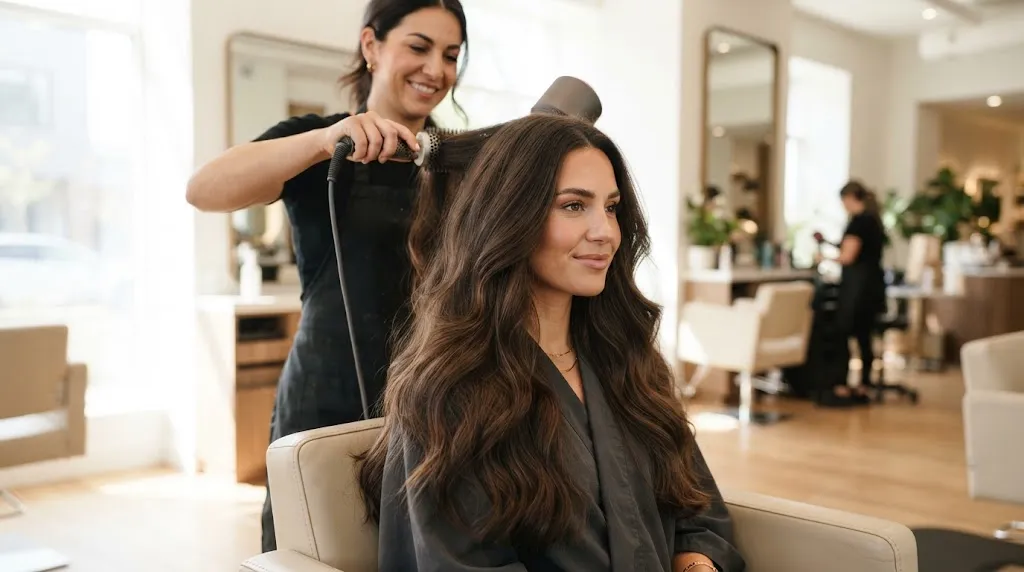
When you sit in the chair, skip the vague requests and tell your stylist: “I need weight taken out through the mid-lengths with interior slide-cutting, but I want to keep my perimeter heavy and blunt so my ends don’t look stringy.” That exact phrase tells us you understand how to manage dense weight without losing your density line.
Mastering long thick hair at home starts with an air-dry routine that prevents the dreaded triangular puff. Towel-boofing with a standard terrycloth towel just roughs up the cuticle; instead, squeeze out excess water using a microfiber cloth or an old cotton t-shirt, working a lightweight cream through your mid-lengths while your hair is still soaking wet. Section your damp hair into four loose twists and pin them up for twenty minutes to set the root direction, then drop them to let the natural wave pattern finish drying smoothly without frizz.
When you bring out hot tools, protecting your investment in your hair means changing how you apply heat. Mist a thermal spray section by section—never spray the whole head at once, or you’ll get wet spots that fry under the plates—and use a wide-barrel styling tool on a medium heat setting rather than max blast. Because thick strands hold heat longer, pass the iron through larger, cleaner sections just once instead of clamping small sections multiple times.
If you are pulling your mane back for a professional setting, a polished look from these office-hairstyles collections works best when you anchor the heavy weight with two crisscrossed large pins rather than relying on a single weak clip.
Growing & Keeping Long Thick Hair Healthy
Genetics vs. Habits — what you can/can't control

When you are working with long thick hair, you quickly realize your genetics hold all the cards regarding your baseline strand density and follicle shape. You cannot change your natural hair growth cycle or the thickness of individual hair fibers, because those traits are hardwired into your DNA.
What you can control is how you treat the fiber once it clears the scalp. Your daily handling habits dictate whether your strands reach terminal length or break off midway down the shaft. Think of your genetics as the hand you are dealt, while your moisture routines and mechanical care determine how you play it.
What Damages Thick Hair Fastest
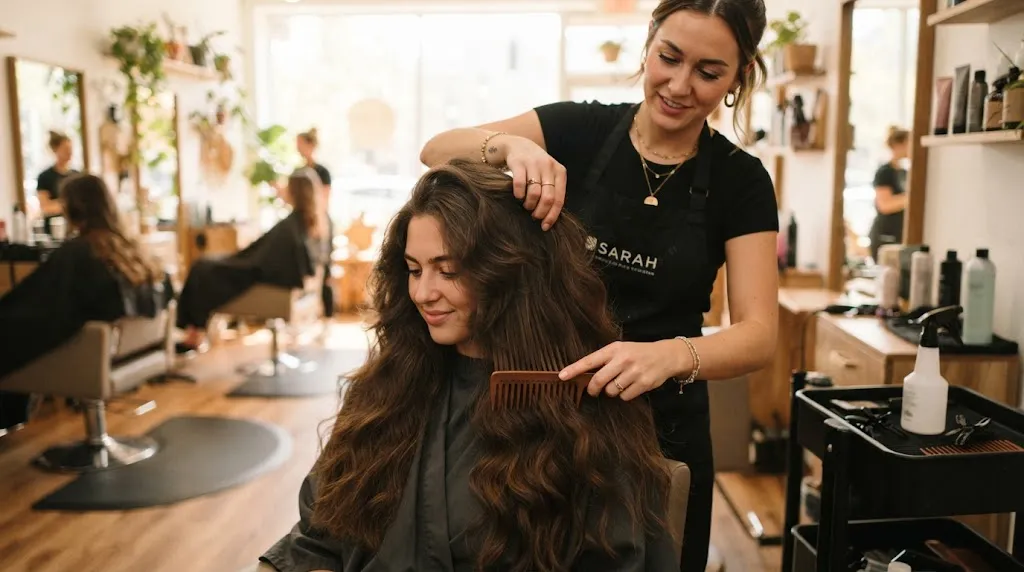
Heavy hair is uniquely vulnerable to mechanical stress and hidden moisture retention. The two fastest ways to wreck long thick hair are aggressive detangling from the roots down and skipping proper drying time after a wash.
When dense hair stays damp too long, the cortex swells and weakens, leading to internal snapping when you pull a hair tie through it.
Ripping through tangles: Starting at the scalp instead of working your way up from the ends creates knots that shred the cuticle.
Thermal overprocessing: Cranking flat irons too high to flatten volume cooks the protein bonds in coarse strands.
Incomplete drying: Tying up heavy, water-logged hair traps moisture and causes friction-based breakage along the nape.
Protective Styling & Nighttime Routine

Protecting heavy hair overnight prevents the friction that causes midday frizz and split ends. Before bed, swap traditional cotton pillowcases for smooth satin or silk to let the heavy weight glide without snagging.
Gather your hair into a loose, high pineapple pony secured with a soft silk scrunchie, or loosely braid it down your back to keep it from getting trapped under your body weight while you sleep.
Stylist Tip: Tell your stylist you want a gentle, snag-free bedtime routine that won’t leave weird kinks in your mane by morning.
Diet & Supplement Basics (factual, no medical claims)

Hair is built from tough structural proteins, meaning your daily intake plays a direct role in how strong new growth emerges from the follicle. While no supplement can magically override genetics or instantly grow out a bad haircut, eating a balanced diet rich in lean proteins, iron, and healthy fats provides the raw building blocks your body needs for optimal keratin production.
Focus on whole foods like eggs, fish, leafy greens, and nuts to support overall follicle health from the inside out. If you suspect a nutritional deficiency is causing excessive shedding or brittle strands, consult a physician or registered dietitian rather than relying on over-the-counter miracle pills.
Quick Comparison Table
| Haircut | Best Texture | Best Face Shape | Maintenance | Styling Time |
|---|---|---|---|---|
| Long Layered Cut | Wavy, straight | Oval, round, heart | Medium | 15–20 minutes |
| Face-Framing Shag | Coarse, wavy, curly | Square, diamond | Medium to high | 20–25 minutes |
| Blunt Heavy Cut | Fine individual strands (high density) | Long, oval | Low to medium | 10–15 minutes |
| Long Curtain Bangs with Layers | Straight, wavy | Round, heart | High | 15 minutes |
| V-Cut Shape | Thick and dense | Oval, hourglass | Low | 10–20 minutes |
Frequently Asked Questions About Long Thick Hair
Yes, absolutely. Long, thick hair is entirely achievable, though it requires managing the heavy weight and potential bulk by using strategic internal thinning or weight-removal techniques rather than just blunt growing.
A long layered cut or a soft U-cut works best because it removes excess bulk and distributes the hair's natural weight evenly, preventing a heavy, triangular shape.
Growing out thick hair depends on maintaining a healthy scalp, minimizing heat damage, and getting regular dusting trims to split ends so the strands don't snap off mid-shaft.
Thick hair looks stunning at any length, but shorter cuts require more daily styling to control volume, whereas long styles let gravity naturally weigh the hair down.
Hair density and strand diameter generally peak during late adolescence and early adulthood, typically between the ages of twenty and thirty.
Hair length is entirely subjective, but mid-back lengths on long, thick hair tend to showcase the hair's natural health, shine, and fullness most dramatically.
Neither length inherently makes you look younger; instead, a flattering cut that complements your face shape and modern maintenance routine creates a fresh, youthful appearance.
People of indigenous, Asian, and Latin American descents frequently have high hair density and coarser individual strand diameters, though thick hair appears across all ethnicities.
Both hair textures possess unique aesthetic advantages, and beauty standards vary widely across cultures and personal preferences rather than relying on a single texture.
This general rule refers to the average quarterly growth cycle of about one to one-and-a-half inches, helping clients set realistic expectations for transitioning between major haircut lengths.