
Children Hairstyles: 30 Latest Hairstyle Ideas for Girls and Boys (2026)
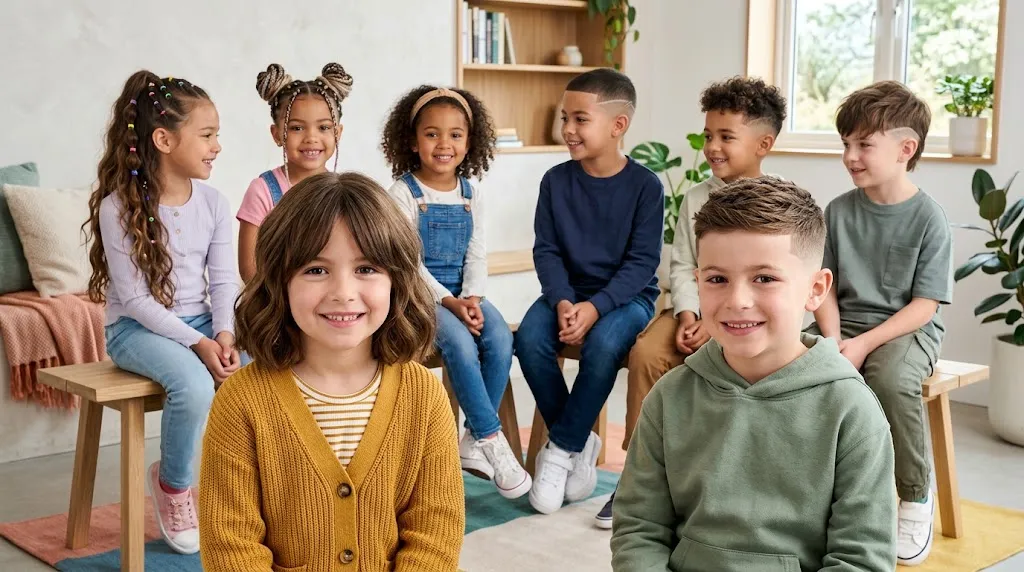
What Are the Latest Hairstyles for Children in 2026?
Children’s hair trends this year focus on low-maintenance textures, quick morning routines, and protective styling that holds up during active play. Search data and salon request counts show that parents are leaning toward styles that look neat without requiring heavy products or daily heat.
Middle parts with curtain bangs: Rising sharply in parent searches, this frame-shaping style gives girls and tweens a soft, modern look that grows out gracefully.
Textured crops: The top requested short cut in child-focused salons, featuring short sides and layered length on top for easy, touchable styling.
Low-taper fades: A staple for boys that keeps hair neat around the ears and neck while keeping the overall cut age-appropriate.
Modern kids’ mullets: A practical option with closely clipped sides and longer back length that keeps hair entirely out of the eyes during school and sports.
Knotless box braids: The go-to protective style for textured hair because it reduces tension on the child’s scalp compared to traditional braided extensions .
Heart-shaped cornrows: A popular scalp-braid design that adds a playful pattern while keeping hair secure for up to two weeks .
What Is the Most Popular Hairstyle for Kids? Top 10 at a Glance
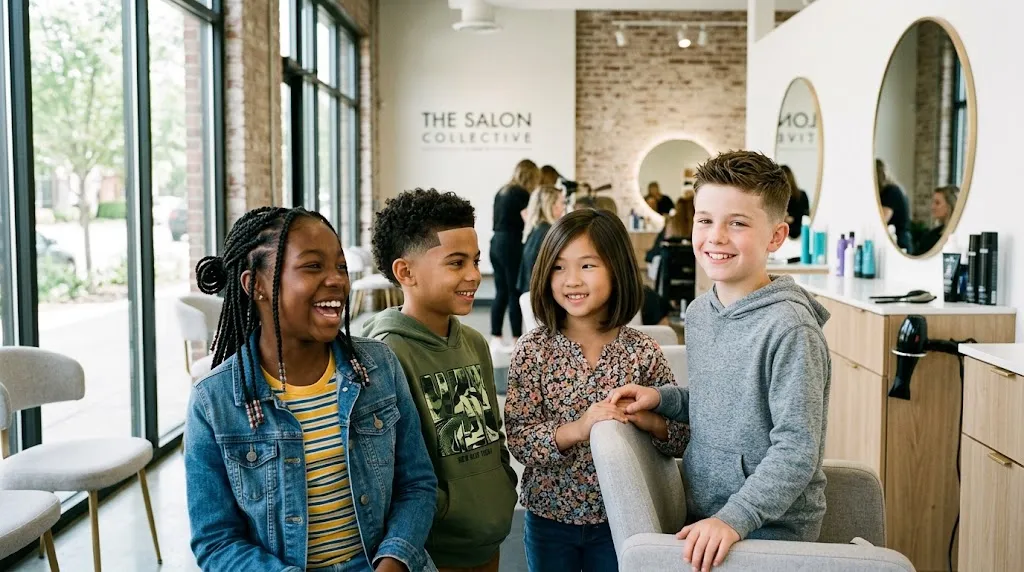
The overall most requested style for girls is the low-maintenance shoulder-length bob because it avoids morning tangles while staying long enough for pigtails [VERIFY: Most requested salon booking data]. For boys, the textured crop takes the top spot as it works with straight, wavy, or curly hair and requires almost no daily product [VERIFY: Salon request data].
Shoulder-length bob: A versatile baseline cut that fits every hair density and stays easy to brush.
Textured crop: A short, layered top with clean edges that handles messy play effortlessly.
Knotless box braids: A gentle protective choice for natural hair that minimizes scalp pull.
Low-taper fade: Neat around the perimeter with custom length kept on top.
Curtain bangs with long layers: A soft frame for older kids moving past simple straight cuts.
Classic kids’ mullet: Keeps fringe out of the eyes while leaving fun length in the back.
Heart-shaped cornrows: A structured, neat braid design that lasts through school weeks.
Curly high-top fade: Defines natural curls on top while keeping the sides trimmed close.
Half-up top knot: A two-minute fix for long hair to keep strands out of the face.
Layered lob (long bob): An easy transition cut for kids growing out shorter styles.
Cute and Simple Hairstyles for Kids
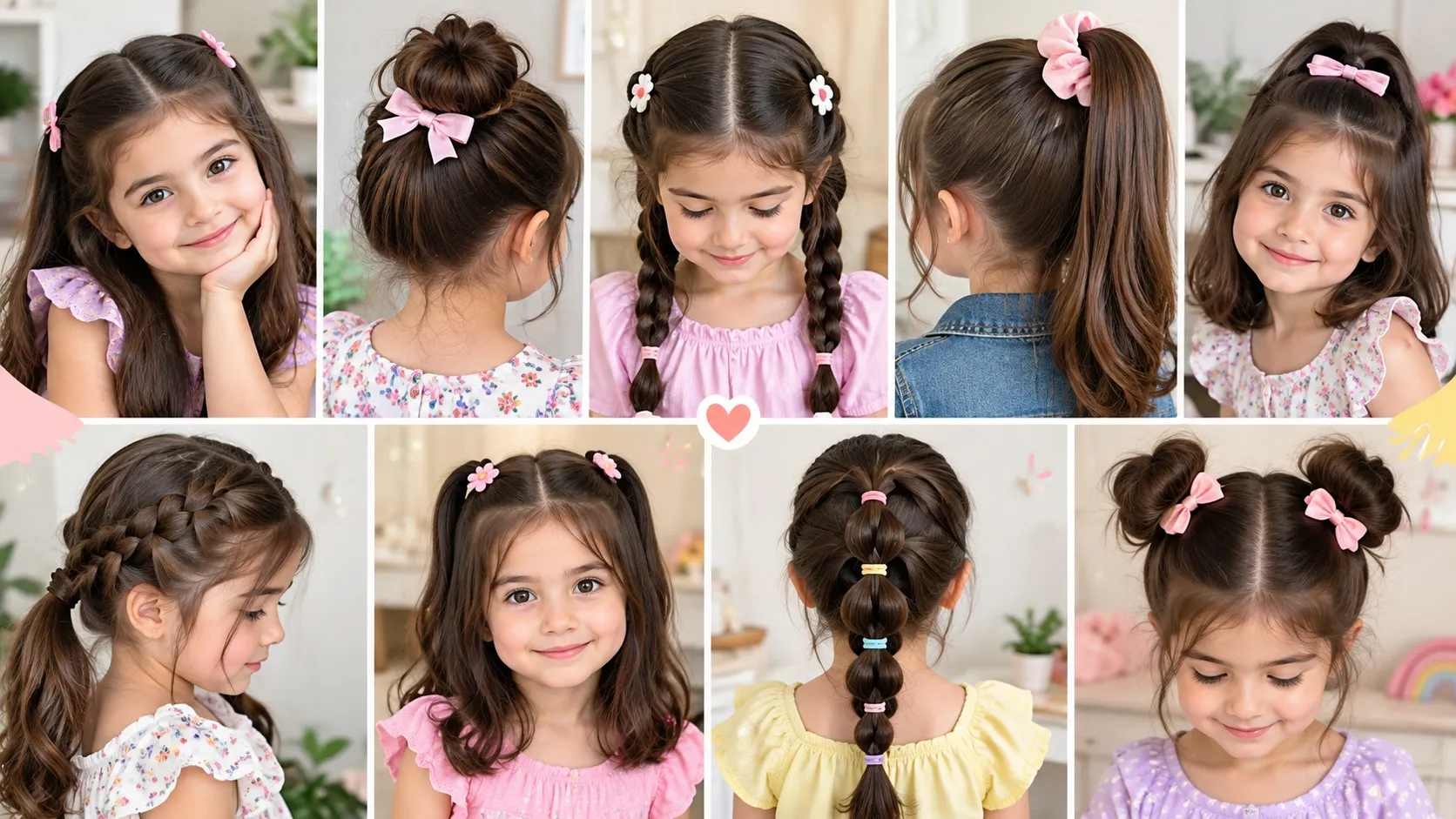
For a quick weekday morning, pick a bubble ponytail or a messy half-up bun: neither needs braiding, and both survive a school bag and a cap. Before a 7:40 a.m. bus, tie one ponytail, add a small elastic every 3 to 4 inches down its length, then gently loosen each gap with your fingertips so the rounded “bubbles” appear. Selecting quick and cute hairstyles keeps mornings calm while giving your child a neat, secure look that holds up through recess.
Bubble Ponytail
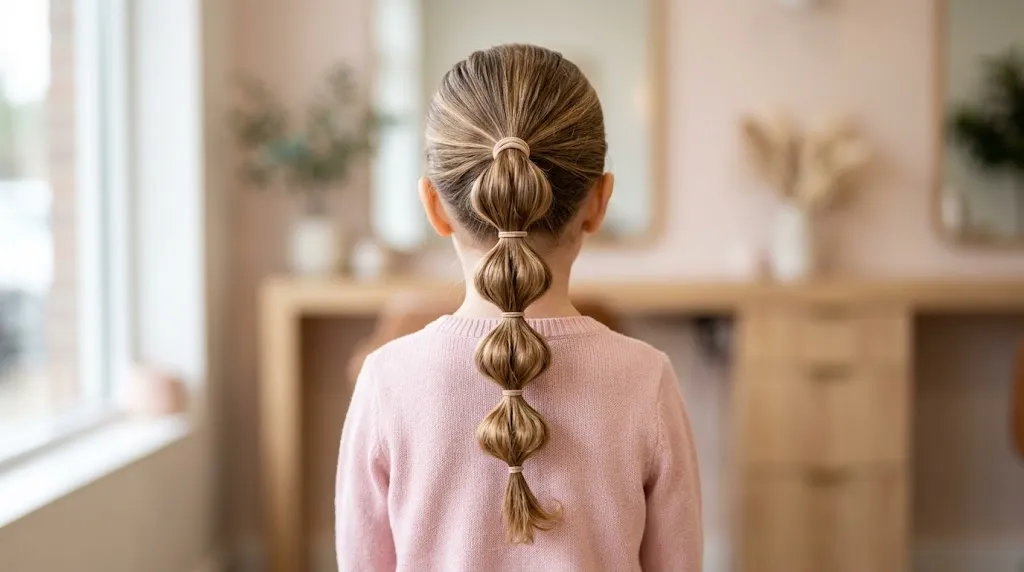
Picture a school morning where you have five minutes before heading out the door, but your child wants a fun, detailed style. The bubble ponytail solves this fast by turning a plain pony into a series of rounded, sphere-like segments using only soft elastics. It works best on medium to long hair with straight or wavy textures that allow the bubbles to puff out evenly.
Spacing the elastics according to your child’s hair length keeps the style proportional:
Shoulder-length hair: Space elastics 2 inches apart for 2 or 3 mini bubbles.
Mid-back hair: Space elastics 3 inches apart for 4 or 5 full bubbles.
Waist-length hair: Space elastics 4 inches apart for maximum puff and drama.
This style provides a dependable 8-hour hold that stays intact through gym class and outdoor play.
Brush the hair back and secure a smooth ponytail at the middle of the head with a fabric-covered hair tie.
Slide a small elastic around the ponytail 2 to 4 inches down from the main base.
Gently pull the sides of that hair section outward with your thumb and forefinger to form a rounded bubble shape.
Repeat down the entire length of the ponytail, leaving 1 to 2 inches free at the bottom end.
To prevent discomfort, avoid pulling the initial crown ponytail too tight against the scalp, and never use bare rubber bands that pinch or snag fragile strands.
Perfect Ponytail
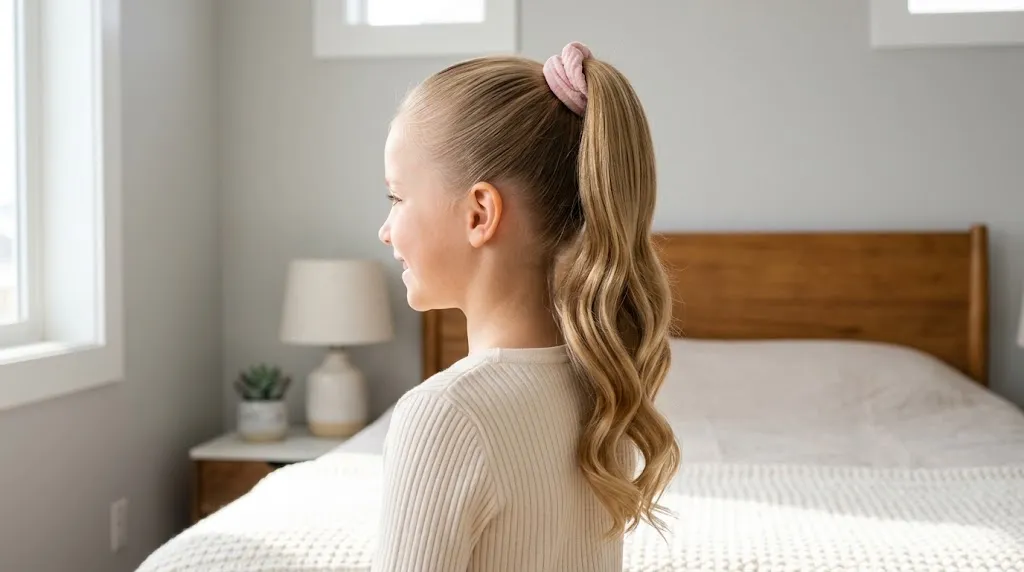
A perfect ponytail is the most versatile daily standard, giving kids of any age a clean look that keeps hair out of their eyes. It fits any hair length from chin-length bob cuts to long locks, accommodating straight, wavy, or curly hair effortlessly. When taken down at the end of the day, it leaves behind soft, heat-free waves that simplify evening styling.
You can adapt this single setup three different ways throughout the week: start with a smooth classic pony on Monday, twist the length into a rope braid on Tuesday, or unbrush it on Wednesday for a soft twist-out texture. Named variations like a Low Ponytail sit comfortably under bike helmets, while Twists and Ponytails (double ponytails) offer a playful option for younger kids.
Expect a solid 6- to 8-hour hold when secured with a sturdy fabric elastic.
Comb all hair thoroughly to remove any tangles or knots.
Gather the hair at your desired height—low at the nape, mid-head, or high near the crown—using a soft paddle brush.
Smooth down any bumps along the top and sides with your palm.
Wrap a stretch-resistant elastic around the base three times to hold it firm.
Avoid gathering the ponytail so high or tight that it pulls at the skin around the temples, which causes discomfort and hairline stress.
Messy Half-Up Bun
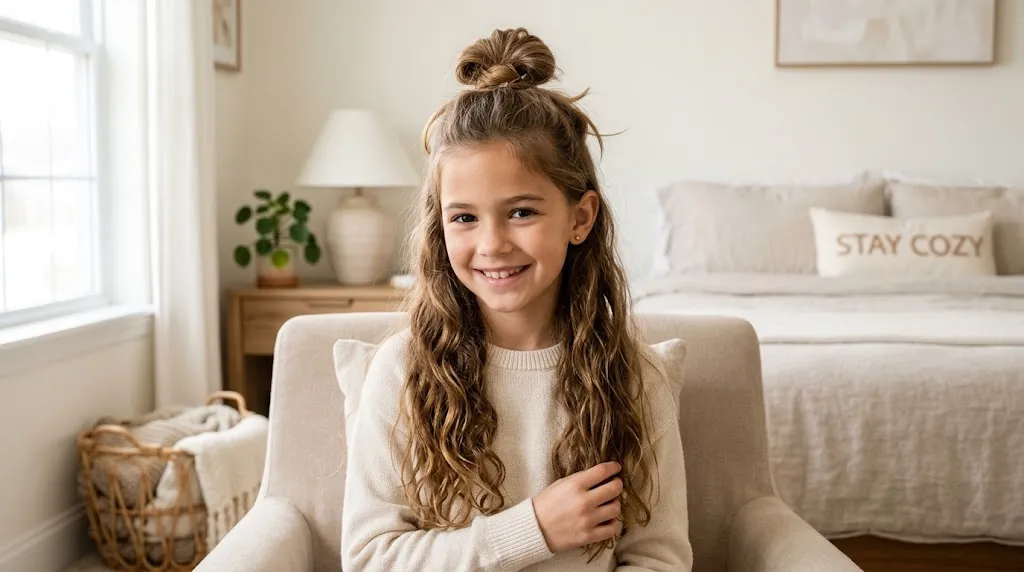
Why spend twenty minutes intricate-braiding when a top-half twist creates an effortless look in under two minutes? The messy half-up bun gathers the hair surrounding the face while leaving the lower half free to show off natural length and pattern. It suits medium to long hair across all textures, from fine straight strands to tight coils.
Using a mini claw clip instead of a tight elastic offers a gentle option for children who dislike the pulling feeling of traditional hair ties. Elastics provide a firmer grip for active sports days, whereas claw clips offer a tension-free hold for classroom focus.
This style delivers a flexible 4- to 6-hour hold that is easy to adjust on the go.
Separate the top section of hair from the top of the ears up to the crown using your index fingers.
Gather this top section and twist the hair loosely from base to ends.
Wrap the twisted length around its own base to form a small, relaxed bun.
Fasten the bun with a small claw clip or a soft elastic band.
Avoid twisting fine or delicate hair too tightly, as over-twisting can snap fine strands near the crown.
Bow Top Bun
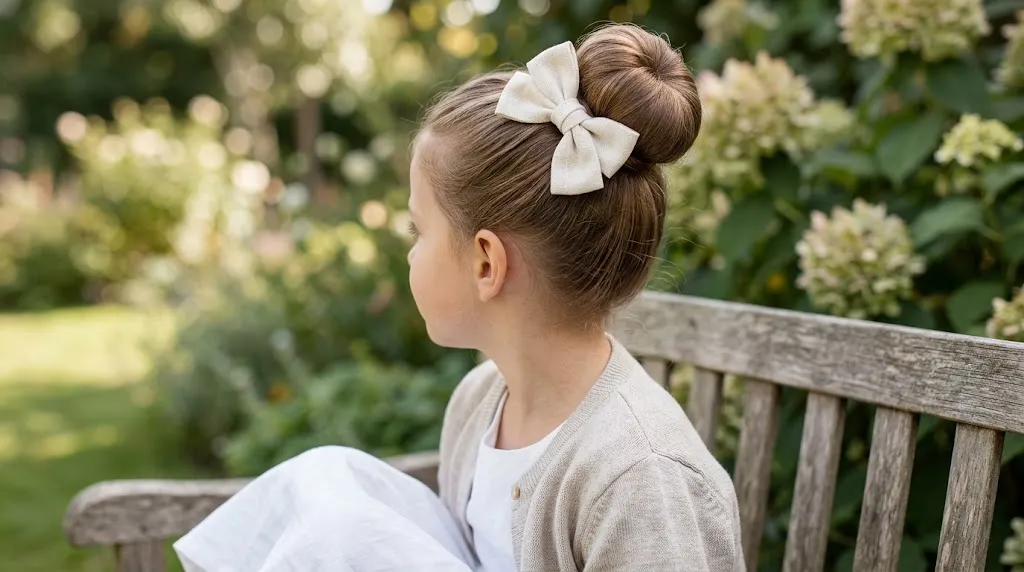
The bow top bun elevates a classic top-knot into a dressy style suited for family gatherings, photos, and school events. It gathers all hair high on the head into a rounded ballerina bun, anchored by a fabric bow accessory. It works best on medium to long hair that has enough length to wrap completely around an elastic base.
Select accessory sizes based on your child’s age and activity level. Large, structured bows add a dressy touch for older kids, while small fabric clips keep the style light for younger children.
This style delivers a secure 6-hour hold for events and school activities.
Sweep all hair into a high ponytail near the crown and secure it with a soft elastic.
Twist the ponytail tail firmly from the base down to the ends.
Coil the twisted tail smoothly around the elastic base to create a rounded bun shape.
Push two or three bobby pins into the base of the bun to secure it, then clip a bow directly onto the front or top of the bun base.
Avoid using oversized, heavy bows that weigh down fine hair, and avoid small detachable accessory clips or loose beads for toddlers due to potential choking hazards.
Sleek Bun
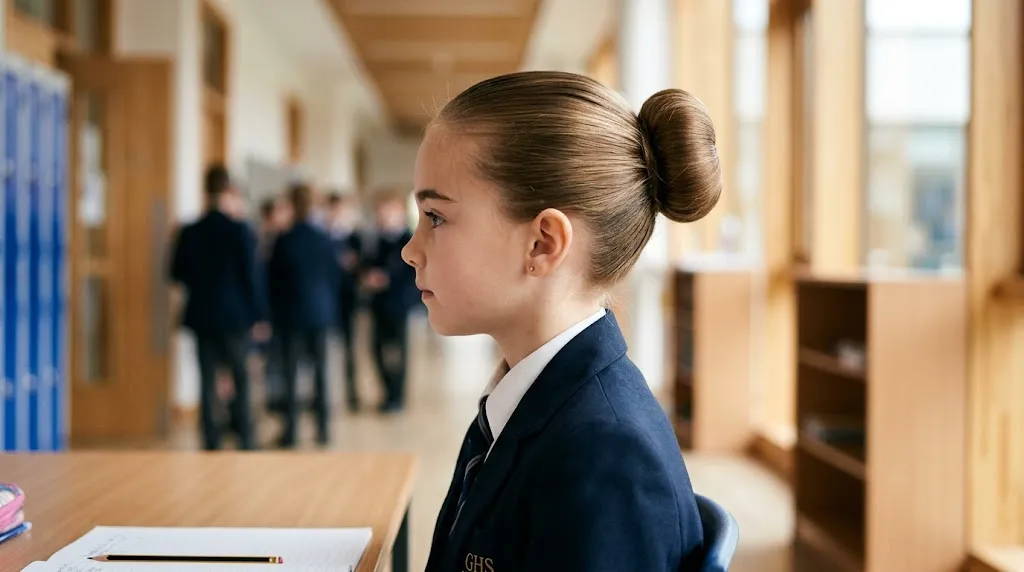
While a messy bun embraces casual flyaways, a sleek bun focuses on smooth lines and neat edges that stay secure all day. This makes it ideal for dance recitals, sports matches, and school picture days where hair needs to stay strictly in place. It suits medium to long hair across straight, wavy, and textured types.
For a playful variation, split the hair down the center part to create double sleek buns (often called space buns). You can also create “Creative Colorful Buns” by weaving bright, lightweight cords or colorful strings into locs or twists before coiling them into their bun shape.
This dance-grade style reliably provides a 10-hour hold through rigorous physical activity.
Brush through the hair, applying a tiny drop of leave-in conditioner or water to smooth flyaways.
Gather the hair into a low or mid-height ponytail, combing the top and sides flat against the head.
Twist the ponytail securely and wrap it tightly around the base to form a compact circle.
Anchor the edges with hairpins and wrap a fine hairnet or decorative elastic over the top.
Avoid coating fine hair with heavy gels or stiff hairsprays, which dry out the scalp and make evening brushing difficult.
Criss-Cross Ponytails
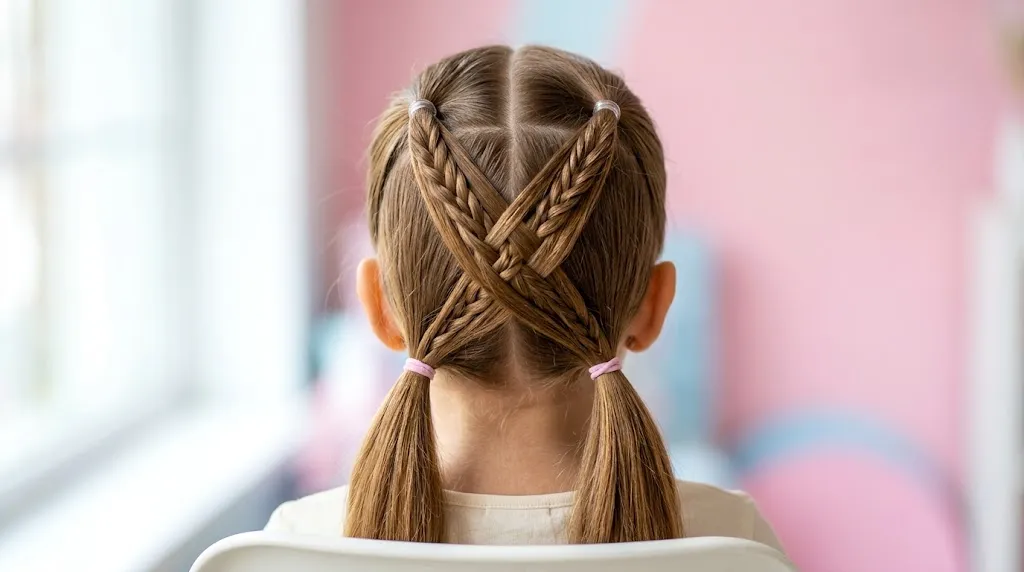
Unlike standard twin ponytails that fall straight down the sides, criss-cross ponytails add an intersecting design across the crown before anchoring into two low bases. This pattern creates a polished, detailed appearance while keeping fine front strands from falling forward into the face. It suits medium to long hair with straight, wavy, or curly textures.
For physical education classes or outdoor sports, gather the crossing strands tighter to prevent sweat build-up at the forehead.
This intricate-looking weave provides an 8-hour hold that resists tumbling and running.
Part the hair down the middle from forehead to nape, then divide the front top section into two equal square boxes.
Tie off each front box with a small clear elastic to form two mini accent ponytails.
Cross the right mini ponytail over to join the left back hair section, and cross the left mini ponytail over to join the right back hair section.
Secure each side into a low ponytail with a standard fabric hair tie.
Avoid making the initial crown sections too small or pulling the criss-cross strands excessively tight, which can stress delicate hairlines.
Pigtails
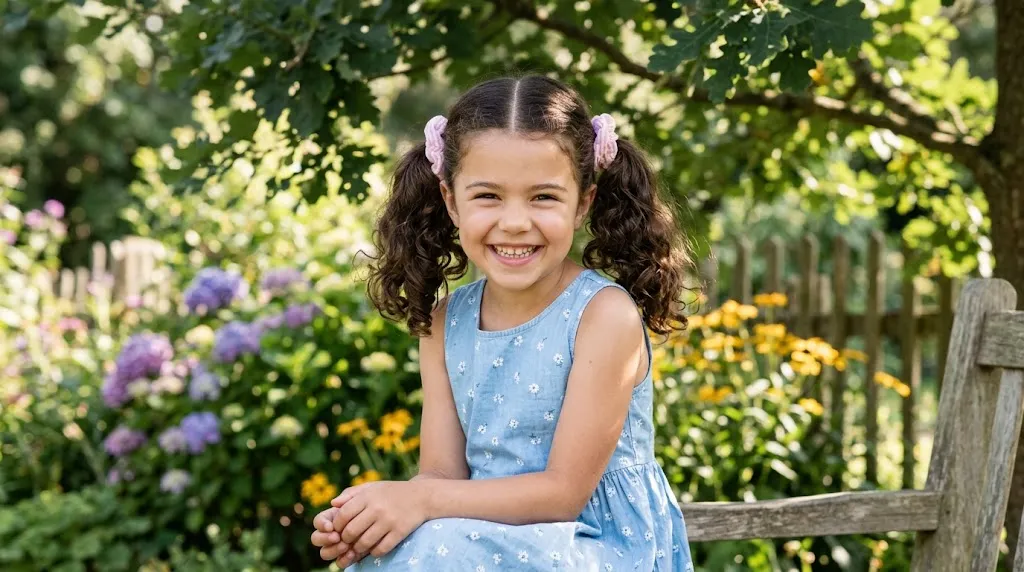
Pigtails are often thought of as a style exclusively for toddlers, but two balanced side ponytails remain a practical, charming option for kids of any age. By anchoring hair evenly on both sides of the head, pigtails distribute tension across the scalp while keeping hair clear of collars and backpack straps. They suit any hair length from chin-length bobs to long strands.
To guarantee a perfectly straight center part every time, use the tip of a plastic tail comb to draw a line from the bridge of the nose straight back over the crown. For children with sensitive scalps, position the pigtails low at the nape of the neck rather than high near the ears to minimize tension.
This classic style offers a durable 8-hour hold for full school days.
Create a straight center part from the front hairline down to the nape using a wide-tooth comb or tail comb.
Clip one side out of the way while you gather the first section at your desired height.
Smooth the gather with a soft brush and secure it tightly with a fabric elastic.
Repeat the process on the opposite side, using the first pigtail as a height guide for symmetry.
Avoid placing pigtails at uneven heights or creating crooked parts, which pull unevenly on the scalp throughout the day.
Kids Hairstyle Tutorials You Can Follow Step by Step
Pick a style above, then watch it being done before you try it at home.
Playlist by GlamFam Hair & Beauty · Watch on YouTube
Children Hairstyles for Girls: Haircuts for Every Length
Finding the right haircut for a girl means balancing what she wants with how much time you have on busy mornings. Below are the top cut options based on length and hair texture. If you want to jump straight to the overall latest hair style for kid girl, check out our top picks: the classic Bob Cut for short-to-medium hair, the Pixie Cut for active kids, and Long Hair with Bangs for extra length with face-framing style.
Bob Cut
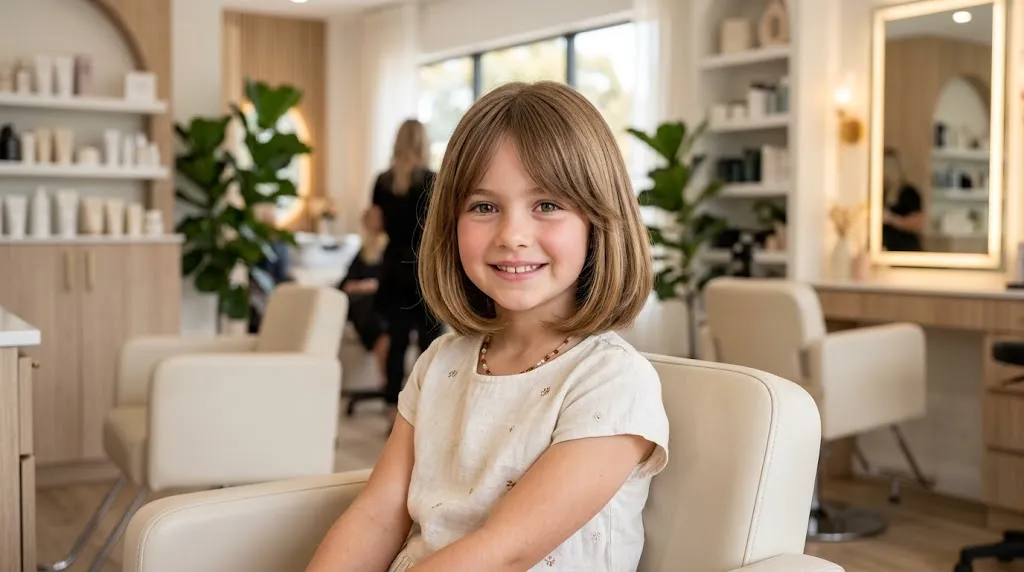
Picture a busy school morning where you spend less than two minutes styling your child’s hair before running out the door. A bob cut gives you a clean, chin-length style that looks instantly put together with just a quick brush. It is the ideal low-styling haircut for girls with straight, wavy, or slightly curly hair who want a neat look that stays out of their face.
To get and maintain this look, follow these simple steps:
Tell the stylist whether you want a jaw-length or chin-length finish, depending on whether she wears her hair tucked behind her ears.
Ask for light interior layering if her hair is very thick, which prevents a heavy “triangle” shape at the bottom.
At home, brush through damp hair, create a natural side or center part, and let it air-dry.
A bob usually maintains its precise shape for six to eight weeks before softening into a shoulder-grazing lob. Avoid getting a blunt, one-length cut on very tight curls without accounting for hair shrinkage, as the length will spring up much shorter than expected when dry. A neat option to consider is the okappa-style bob, a traditional Japanese variation featuring a straight-across cut with full, blunt bangs.
During the grow-out phase, a bob transitions through three distinct stages: the jaw-length classic bob (months 1–2), the neck-grazing lob (months 3–4), and the collarbone cut (months 5–6), which allows you to skip frequent salon trips while maintaining a intentional look.
Pixie Cut

Are morning tangles and long hair prep causing daily battles before school? A pixie cut is a short, playful haircut that eliminates matting, reduces wash-time, and lets active kids run free without hair falling into their eyes. It suits fine to thick straight or wavy hair, especially for children involved in sports or swimming.
When taking your child to the salon for a pixie cut:
Bring 2–3 reference photos showing the exact fringe and side lengths you both like.
Tell the stylist if you prefer softer, textured edges or a cleaner, classic outline around the ears and nape.
Keep daily care minimal at home by combing it forward or to the side while damp, adding a light leave-in conditioner if needed.
A pixie cut needs a trim roughly every four to six weeks to keep its shape. Avoid forcing this cut on a child just for convenience if she loves long hair, as growing out a pixie takes patience and time.
To decide together if a pixie is the right choice, walk through this quick three-question checklist with your child:
do you dislike brushing out tangles every day?
Are you comfortable with your hair being close to your ears and neck?
Are you willing to visit the hair stylist every month or two for quick maintenance trims?
If she answers “yes” to these, a pixie is likely a great match.
Haircut with Bangs
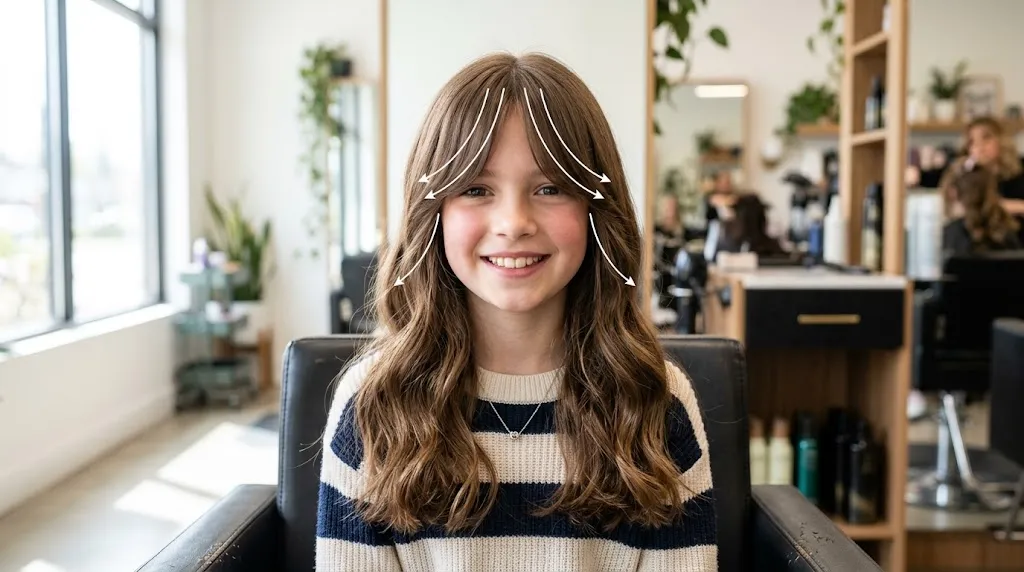
Blunt fringe gives a bold, classic frame to the face, while curtain or see-through bangs offer a softer, flexible look that sweeps easily to the sides. Adding bangs to any cut gives your child a fresh new style without sacrificing her overall length. This option works best for straight or wavy hair types, provided you check for strong front cowlicks first.
Here is how to choose and care for bangs:
Check the front hairline for cowlicks or strong growth patterns that might force the hair to split open.
Ask your stylist for cheekbone-length curtain bangs for easy tucking, or eyebrow-length straight bangs for a classic frame.
Trim the bangs regularly every 3 to 4 weeks to keep them clear of the eyes.
Bangs grow fast and usually need maintenance twice as often as the rest of the hair. Avoid cutting bangs very short over a front cowlick, or the hair will stick straight up instead of lying flat. Another popular variation is Long Hair with Bangs, which pairs cascading length in the back with face-framing fringe in front.
Home trims are safe for minor maintenance once you have an established guideline from a stylist. Use sharp hair-cutting shears—never household scissors—and trim small vertical snips into the ends while dry. If you are changing the shape entirely, cutting a full fringe for the first time, or dealing with stubborn hair swirl patterns, always let a professional stylist set the initial shape in a salon.
Braids and Protective Styles for Children
If you want a hairstyle that holds up through active school days and lasts all week, low-tension cornrows or knotless braids are your best options, while heart braids add a fun touch for school photos and weekends. Setting a protective style on Sunday evening saves time during busy mornings, but always perform a quick tension check at the hairline to make sure your child feels completely comfortable before they head to sleep.
Braids and Beads
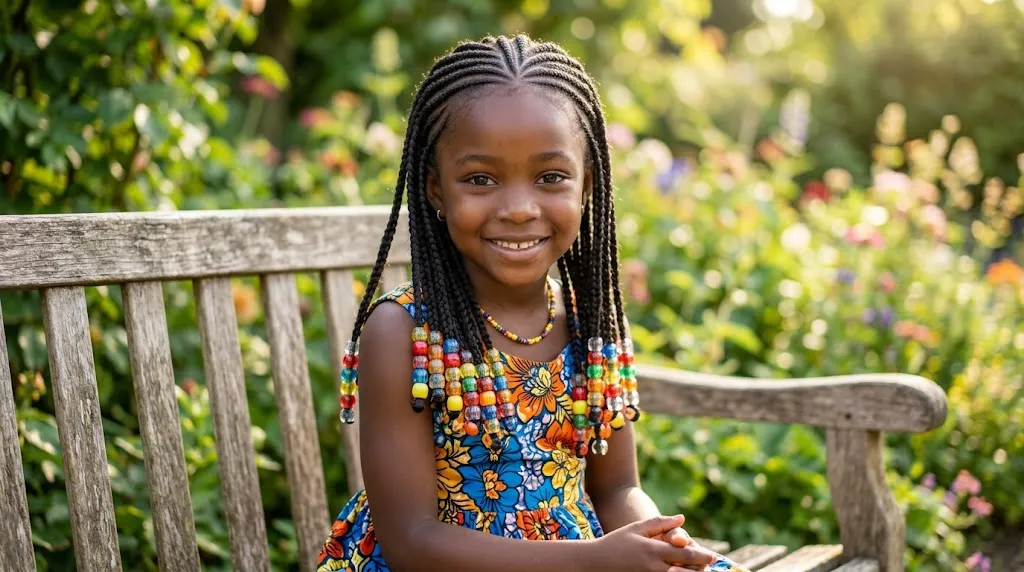
Looking for a style that combines protective braiding with a bit of bright, playful personality for the classroom? Braids with beads offer a secure way to keep hair neat while allowing kids to pick out their favorite bead color combinations.
This style works exceptionally well on textured hair, though straight hair can also hold braided extensions with beads for short periods. Expect the style to stay fresh for 2 to 4 weeks with proper nighttime care like wearing a satin bonnet. While protective styles can technically last longer, the American Academy of Dermatology recommends keeping braided styles in for no longer than 6 to 8 weeks to protect hair and scalp health. Always verify that bead weight is appropriate for your child’s age—too many heavy acrylic beads can weigh down fine strands and pull at the roots. Before installing, also double-check your school’s dress code policy regarding the clicking noise beads make during class. A popular alternative for older kids who want a polished finish is to gather the beaded lengths into braided updos.
Part hair into small, even sections using a rat-tail comb and apply a lightweight styling cream.
Braid each section down to the ends, keeping tension light and consistent.
Thread 3 to 5 beads onto a bead loader or a bent piece of craft wire.
Pass the end of the braid through the beads, fold the tip of the braid up over the bottom bead, and secure it firmly with a small clear elastic band.
Heart Braids
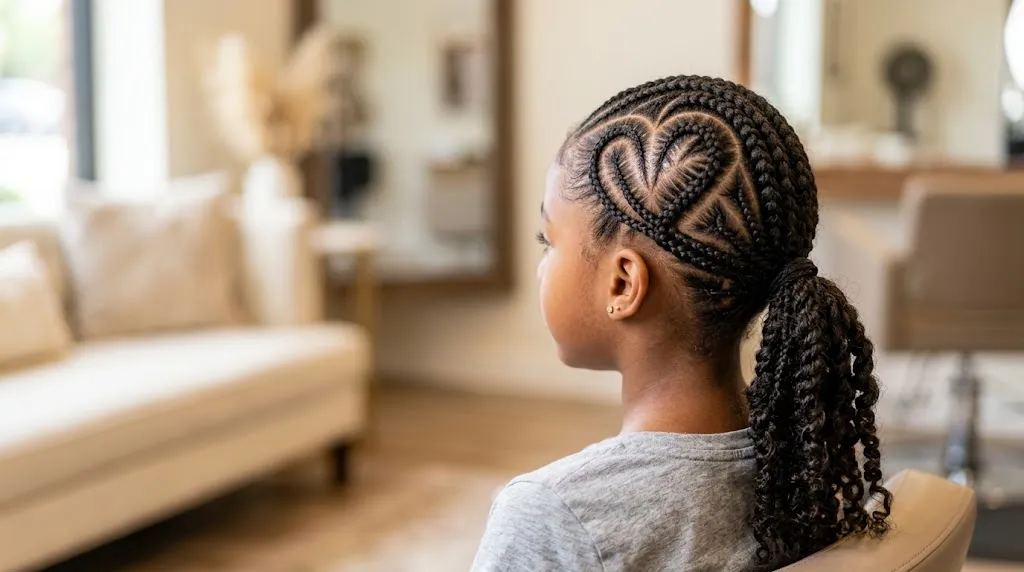
Heart braids feature curved parting lines where scalp-adjacent braids outline a distinct heart shape on the side or crown of the head. It is one of the most requested special-occasion styles for young girls with medium to long hair because it looks intricate while keeping the rest of the hair neatly styled.
The overall style lasts up to 2 weeks if the hair is wrapped at night, though the crispness of the heart outline typically shows visible flyaways after. The main risk with heart braids is pulling hair too tightly around the curved arches of the heart design, which can irritate sensitive skin near the temples. To make this look easier for beginners, try a simplified version: part a standard heart outline, clip the rest of the hair out of the way, and create two simple three-strand surface braids following the shape instead of attempting a full feed-in technique.
Map out a heart shape on dry, detangled hair using a tail comb, securing the surrounding hair with sectioning clips.
Divide the heart shape vertically down the center so you have two symmetric halves.
Begin at the bottom point of one half of the heart, braiding upward along the curved outer line while gathering small, precise sub-sections.
Follow the curve over the top arch and braid downward toward the center line, repeating the process on the opposite side to complete the shape.
Cornrows
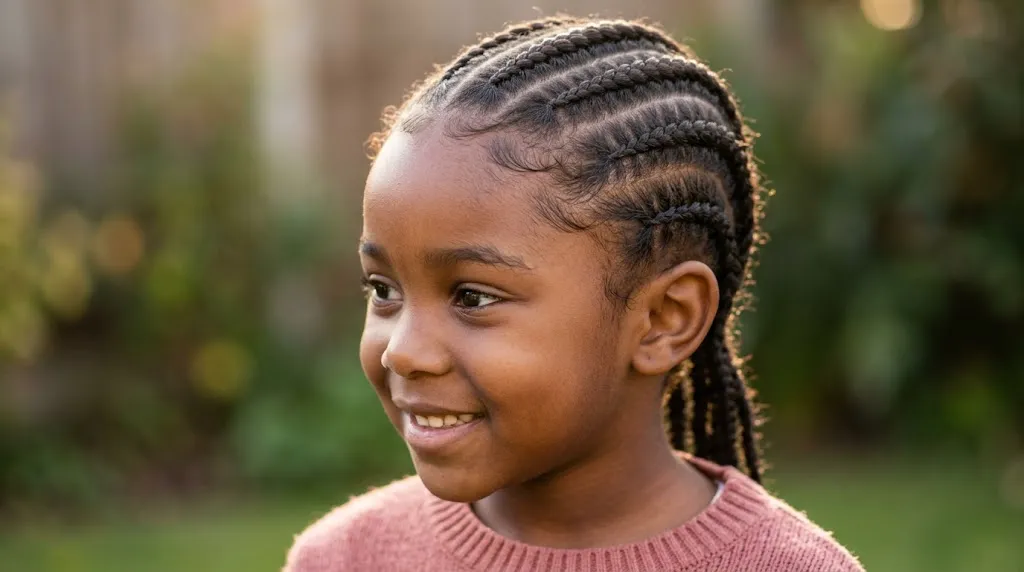
Picture a chaotic Monday morning where you do not have to brush, detangle, or style your child’s hair at all—that is the main appeal of classic cornrows. These flat, underhand braids sit close to the scalp and offer an exceptional low-maintenance solution for coily and curly hair types.
When asking a professional braider for cornrows, specify that you want medium-sized rows with comfortable, low-tension edges. Cornrows easily last 2 to 4 weeks with basic maintenance, staying well within the recommended maximum limits advised by the American Academy of Dermatology. The biggest precaution with cornrows is avoiding excessive tightness; the AAD explicitly warns that tight cornrows can lead to traction alopecia along the hairline. Always perform a quick tension check by asking your child to raise their eyebrows or smile; if the skin on their forehead feels pulled, the braids are too tight. For a fun twist, try feed-in cornrows with a curly ponytail, where extended hair is gradually added for extra length at the back.
Wash, condition, and thoroughly detangle the hair, applying a leave-in moisturizer while strands are damp.
Use a tail comb to create clean, straight parting lines from the front hairline back toward the nape of the neck.
Take a tiny section at the front hairline, divide it into three equal strands, and begin an underhand braid (passing outer strands under the middle strand).
Add a small path of hair to the center strand each time you cross a side strand over, keeping your hands close to the scalp as you work toward the back.
Knotless Braids
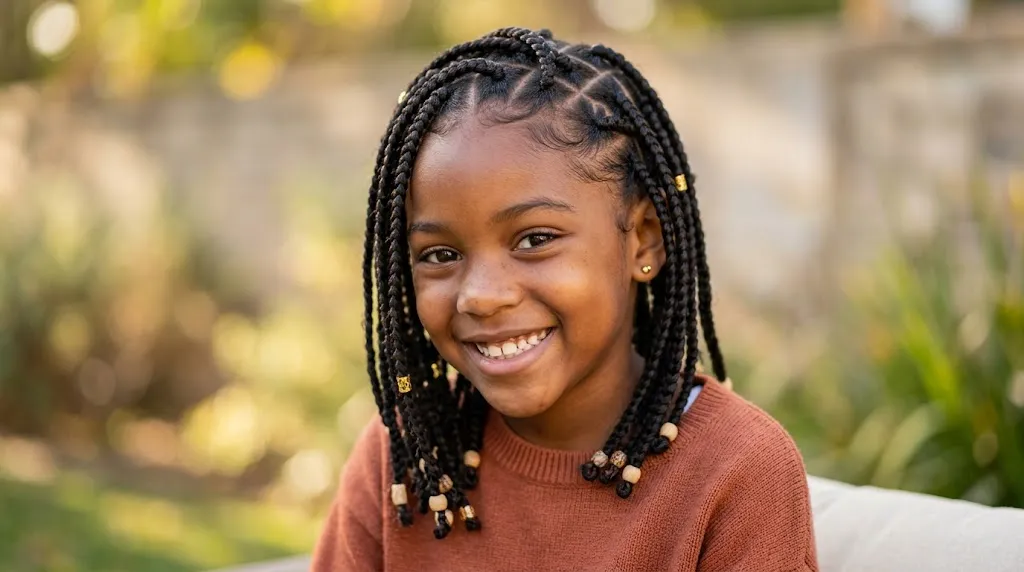
Knotless braids differ from traditional box braids because they begin with your child’s natural hair and feed in synthetic extension hair gradually down the strand. This creates a flat, smooth root that places significantly less weight and tension on the scalp from day one.
This style is ideal for children with dense, textured hair who want longer braided lengths without the uncomfortable “pulling” sensation common with standard box braids. They typically last 4 to 6 weeks, easily respecting health guidelines provided you do not leave them in past the 8-week mark. Despite their comfortable fit, you must still avoid making the individual braids too long or heavy for your child’s neck muscles. When comparing knotless to traditional box braids, professional braiders note distinct trade-offs. Knotless braids take about 1 to 2 hours longer to install and cost slightly more, but they lie flatter, feel lighter, and cause far less scalp sensitivity immediately after styling.
Section detangled hair into small, square or triangle parts using a rat-tail comb and a light parting jam.
Divide the natural hair of one section into three strands and begin a standard three-strand braid for two full crossovers.
Take a thin strip of folded braiding hair and slide it between your thumb and index finger, weaving it into the natural strands as you braid down.
Continue feeding in small, equal strips of extension hair every few passes until you reach the desired thickness, then braid smoothly to the ends.
French Braid
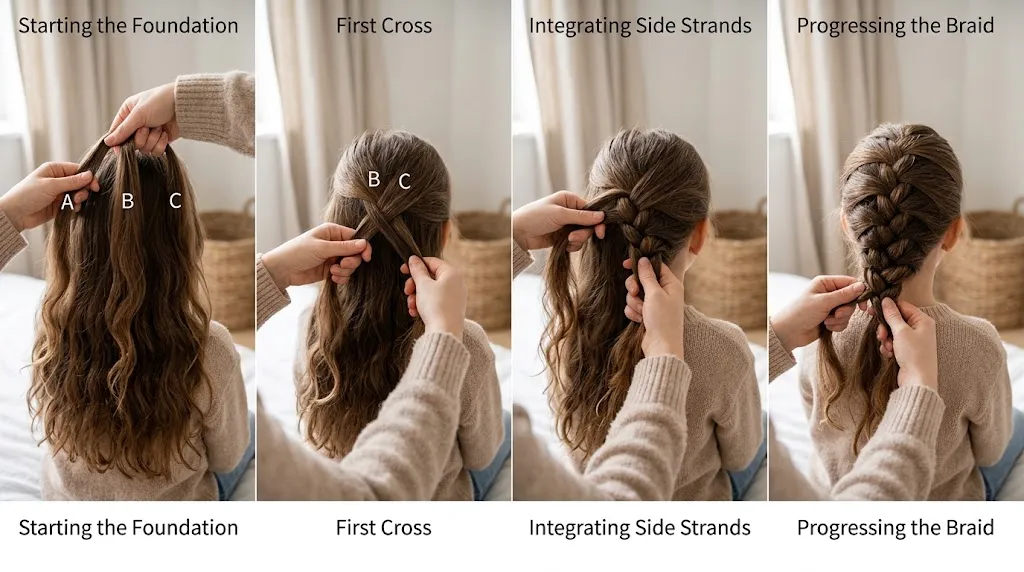
Many parents assume that French braiding requires expert-level hand coordination, but it is actually one of the simplest techniques to master once you understand the basic three-strand crossover. A French braid smoothly picks up hair from the sides as it moves down the head, making it the absolute best style for keeping medium to long hair secure during sports, gymnastics, or pool days.
Works best on straight, wavy, or lightly textured hair that reaches past the shoulders. You can expect a well-done French braid to hold up through a full day of intense school activities, though fine hair may show soft flyaways by late afternoon. Never pull the hair backward so tightly that your child winces or their eyes stretch at the temples—gentle, firm control keeps the hair in place without pain. Choosing between one braid or two comes down to the activity: a single center braid is great for everyday school wear, whereas double French braids (Dutch or traditional) fit much better under bike, softball, or riding helmets. You can also finish a French braid into a Braided Bun, or add tiny fishtail braid accents along the sides.
Brush all hair backward to clear any tangles, then scoop up a small section of hair at the top crown and divide it into three equal strands.
Cross the right strand over the middle strand, then cross the left strand over the new middle strand, just like a standard braid.
Before crossing the right strand over again, gather a small section of loose hair from the right side of the head and merge it into that right strand.
Repeat the process on the left side, continually adding loose hair to each side strand before crossing over, until you reach the nape of the neck, then braid the remaining tail normally and secure with an elastic.
Hairstyles for Curly, Coily and Textured Hair
Curly Half-Up, Half-Down
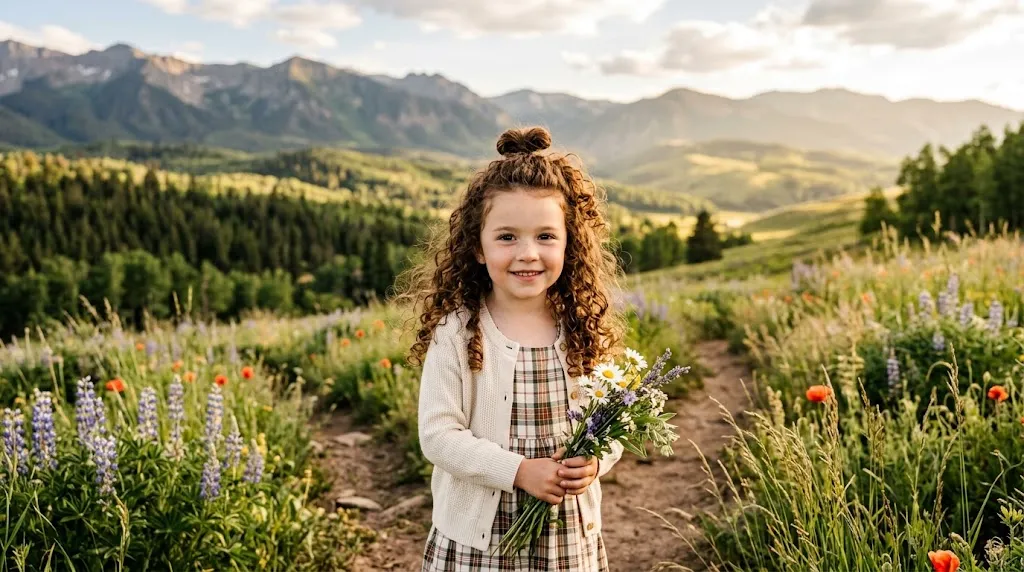
A curly half-up, half-down style keeps curls out of your child’s eyes while letting their natural pattern shine in the back. It gives active kids the best of both worlds by securing the front section while letting the lower layers bounce freely.
This style works best on shoulder-length or longer curly and wavy hair (Types 2B to 3C). It holds its shape for about 8 to 10 hours of typical daily activity [ADD TESTED HOLD TIME]. Never comb or brush dry curls hard to force them into the clip, as this breaks up the curl pattern and causes instant frizz. “Brushing dry curls damages the hair shaft and creates unnecessary tension on sensitive young scalps,” notes an experienced children’s hair expert.
Mist dry or damp hair lightly with water or a curl-reactivating spray.
Separate the top half of the hair from ear to ear using your fingers instead of a fine-tooth comb.
Secure the top section at the crown with a soft fabric scrunchie or a small claw clip.
Gently fluff the loose bottom curls with your fingers.
To keep this style fresh on day two, skip the complete re-do. Simply spray the loose bottom section with a fine mist of water, scrunch upwards, and let it air-dry to revive the bounce. For a slight variation, you can replace the top clip with two small side twist-backs or a single top knot.
Twist-Out
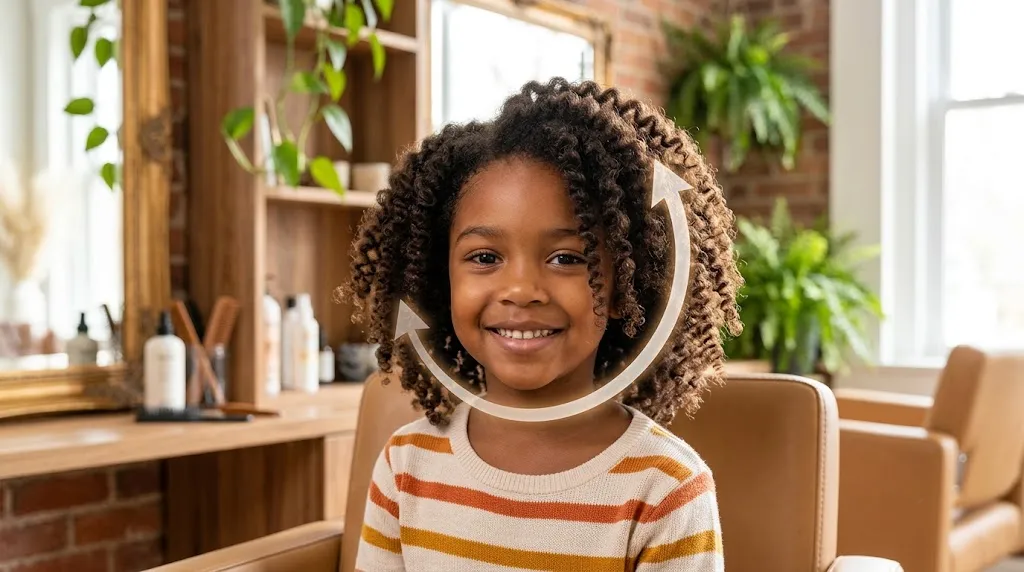
A twist-out gives coily hair soft definition and stretched length without using a single degree of direct heat. While a traditional silk press relies on flat irons that alter the hair structure temporarily, a twist-out relies entirely on wet-to-dry setting, making it a far safer choice for young, delicate strands.
This heat-free method shines on coily and tight curly textures (Types 3C to 4C) that have at least three or four inches of length. Once unraveled, a well-set twist-out easily lasts 3 to 5 days, making morning routines extremely fast [ADD TESTED HOLD TIME]. The main pitfall to avoid is unravelling the twists while they are still damp inside. Separating wet hair ruins the curl definition and leads to immediate tangling.
Apply a leave-in conditioner or curling cream to clean, damp hair.
Section the hair into small square parts across the head.
Divide each section into two equal strands and wrap them tightly around each other from root to tip.
Allow the hair to dry completely overnight.
Coat your fingers with a drop of light hair oil and gently untwist each section from tip to root.
You can customize the finished pattern by changing the size of the initial twists. Smaller twists yield tight, springy definition that lasts longer, while larger two-strand twists create soft, voluminous waves.
Puffs
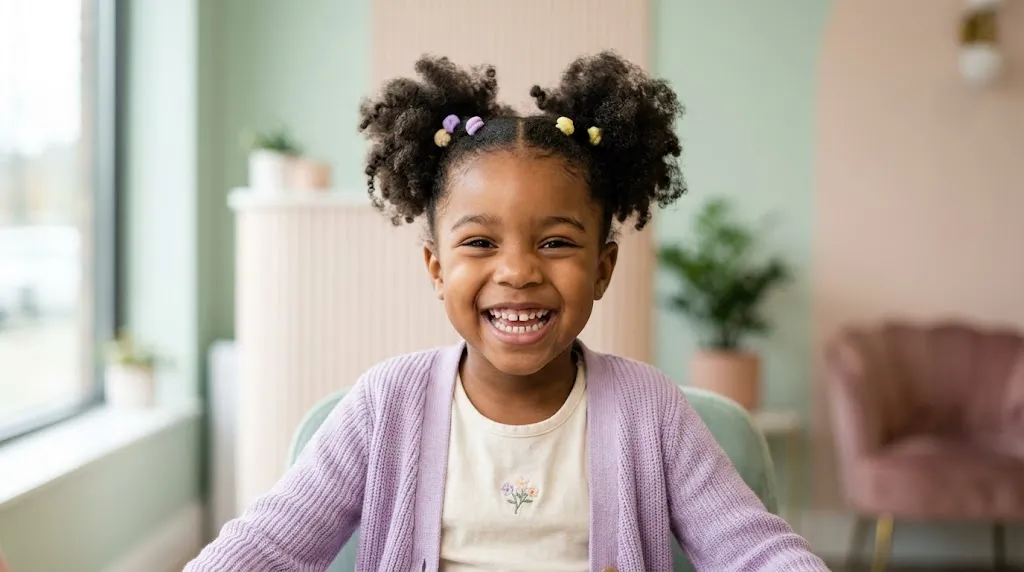
Picture a rushed Monday morning where you have five minutes to get your child out the door with neat, playful hair. A puff gathers coily texture up and away from the face, turning natural volume into a neat, rounded silhouette in moments.
Puffs are ideal for medium to long coily and tight curly textures (Types 4A to 4C). A secure puff holds strong for 24 hours and can easily transition into a second-day style. To protect your child’s hairline, avoid pulling elastics or bands too tightly around the edges. Constant tight pulling at the temples can strain delicate follicles and cause discomfort.
Dampen the edges of the hair with water or a light leave-in conditioner.
Smooth the hair upward toward the top or sides of the head using a soft-bristle brush.
Slip a wide, stretchable fabric headband over the hair, cinching it to the desired puff base.
Fluff the ends gently with your hands or an afro pick to form a full, rounded shape.
Age often dictates whether one or two puffs work best. Toddlers and younger children look adorable with high double puffs (space puffs) that balance shorter hair lengths, while tweens and older kids often prefer a single, high central puff or a low nape puff for a more streamlined look.
Silk Press
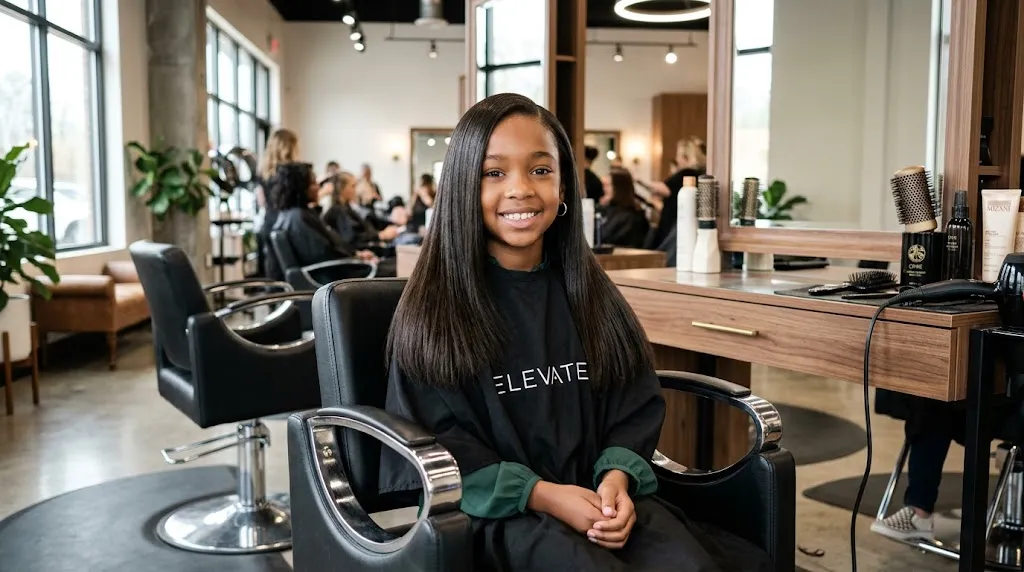
How often can you straighten textured hair without causing permanent heat damage? A silk press temporarily transforms natural curls into smooth, straight hair using a blow dryer and flat iron, but it requires professional care and strict restraint on young hair.
This style suits coily or curly hair when a child wants a temporary straight look for a special occasion. A salon silk press typically lasts 1 to 2 weeks, provided the hair stays completely dry and free from humidity or sweat . Frequent heat exposure can weaken the hair shaft and alter natural curl patterns over time. While a review found heat straightening alone was not significantly linked to traction alopecia, repeated high-heat styling reduces elasticity and increases breakage. Always consult a pediatric dermatologist or an experienced child stylist before scheduling chemical or high-heat services.
A stylist washes the hair with a clarifying shampoo and applies a deep hydrating conditioner.
The stylist applies a professional heat protectant spray throughout the hair.
The hair is blow-dried straight using a tension technique with a paddle brush.
Small, thin sections are passed through a temperature-controlled flat iron set to a safe heat level.
“For young children with natural hair, save silk presses for special occasions no more than two to three times a year,” advises professional stylists. To preserve the style at night, wrap the hair in a silk or satin bonnet, and never re-apply flat irons at home between salon visits.
Children Hairstyles for Boys: Haircuts That Work
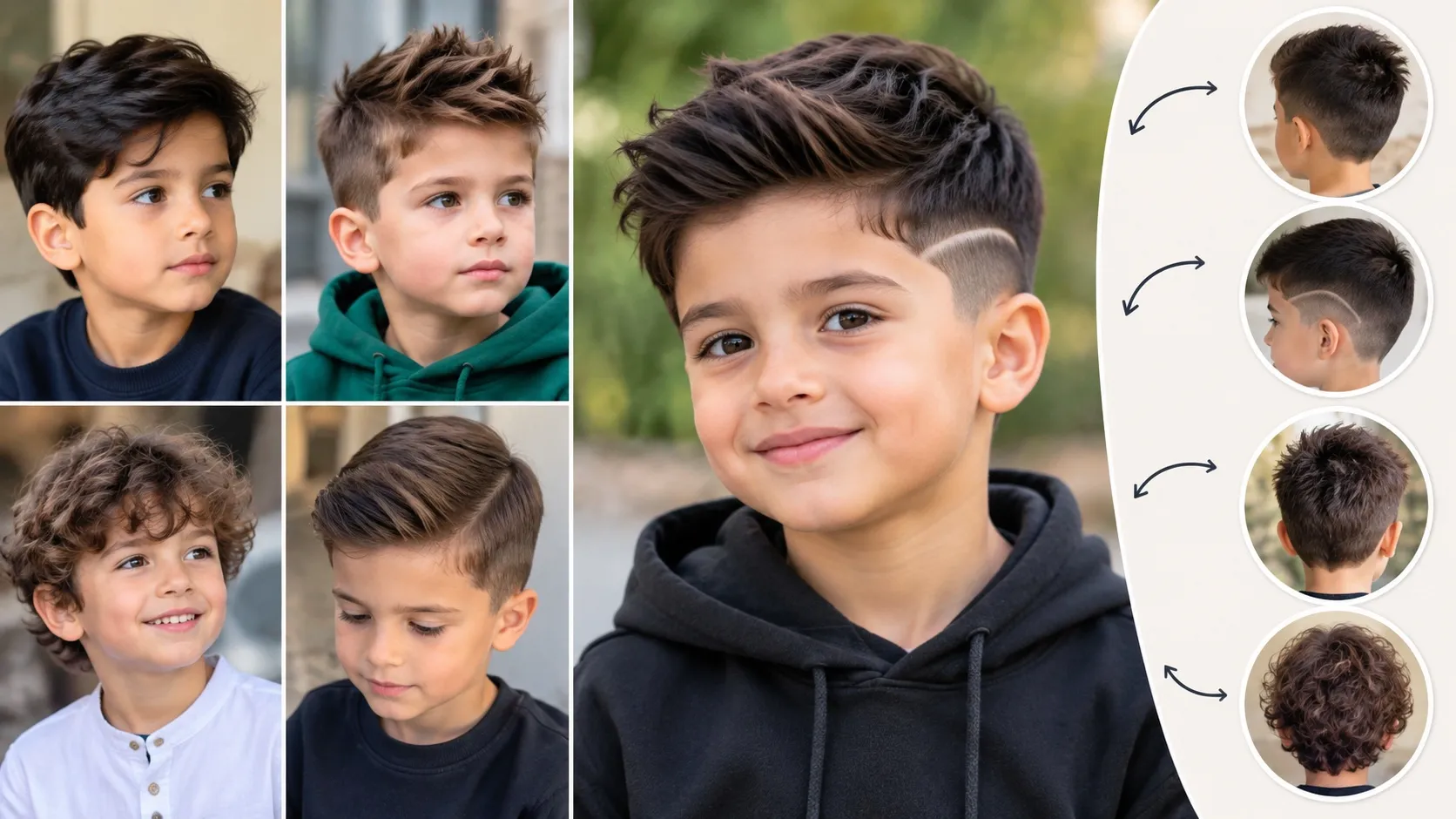
Finding the right children hairstyles for boy clients usually comes down to balancing a kid’s personal taste with a realistic morning routine. While a quick trim seems simple enough, different hair textures, cowlicks, and activity levels can completely change how a cut wears over time. For more boys’ haircut photos grouped by age (2-6 and 7-14), fades, curly and straight hair, see our boys’ hairstyle photo collection. You can also explore our main boys’ hairstyles hub to browse styles by length and occasion.
Crew Cut
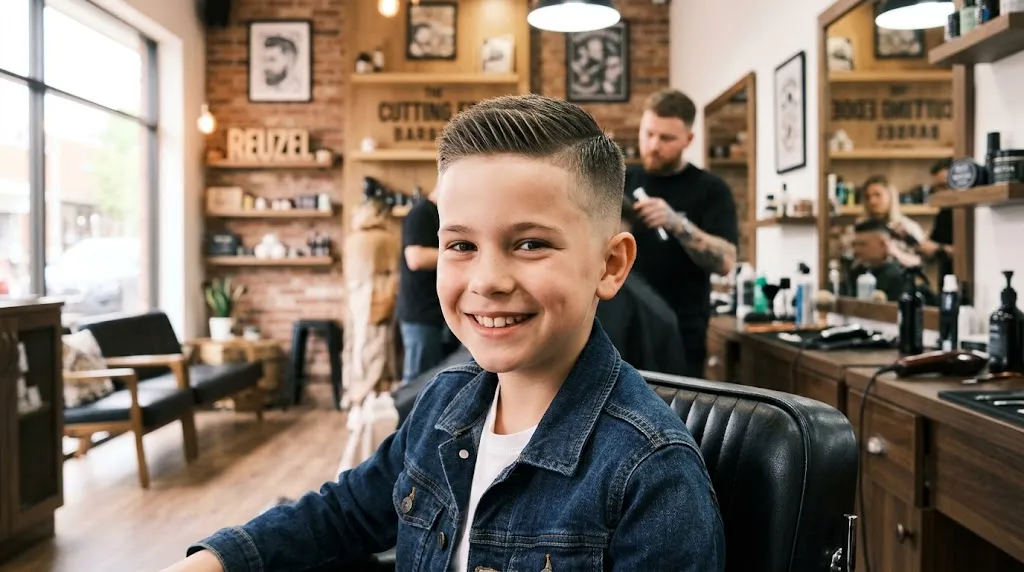
Picture a school morning where you do not need to hunt down a comb or handle a single drop of hair gel. The crew cut delivers that exact ease, featuring tapered, short sides with slightly longer length left on top. It works on virtually every hair type, from fine straight strands to tight coils, and lasts about three to four weeks before the edges need a neat trim. The main mistake to avoid is walking into a salon and simply asking for a “short cut,” which leaves too much to interpretation and often ends with an uneven crop.
Show your barber a photo of the desired length on top and state the exact clipper guard number you prefer for the sides.
Ask the barber to blend the top into the sides smoothly without leaving a sharp ledge.
Have them clean up the neck line in a squared or natural soft curve.
If your child is visiting a barber for the first time, try using this script across the chair: “We want a classic crew cut with a number 2 on the sides, blended up into an inch on top, so we do not have to style it in the morning.” Similar variations include the rounded Caesar Cut, a soft Scissor Cut for kids who get nervous around buzzing clippers, or the extra-short Thai Schoolboy Cut. For a structured geometric shape, our box cut hairstyle guide covers precision lines, though you should check the style first to ensure it suits your child’s hair density and daily routine.
Buzz Cut
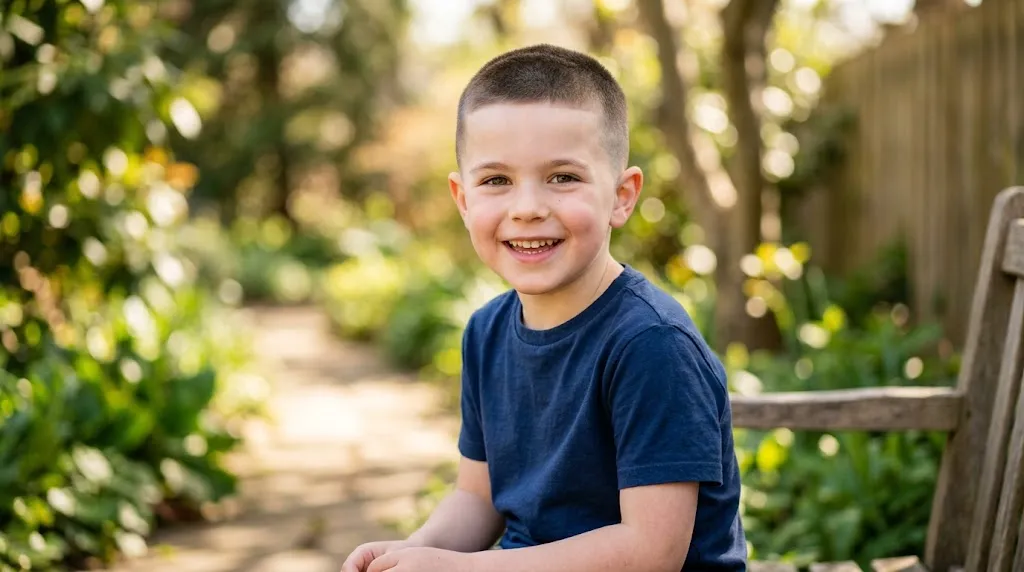
A buzz cut is the absolute simplest haircut for active kids, trimmed to one uniform, short length all over the head using electric clippers. It excels on thick or straight hair and holds its shape perfectly until the hair grows out over three to six weeks. The biggest risk with a fresh buzz cut is leaving newly exposed scalp vulnerable to sunburn. Check with a pediatric dermatology source regarding SPF safety on exposed scalps for toddlers].
Select a clipper guard length with your child, usually between a number 1 (very short) and a number 4 (half an inch).
Guide the clippers evenly across the head against the natural direction of hair growth.
Shape the hairline around the ears and nape for a clean edge.
Before committing to an ultra-short guard, look closely at your child’s head shape, hair density, and any visible cowlicks or crown whorls. Very short guards will reveal birthmarks, bumps, or flat spots on the skull, while a slightly longer guard, like a number 3 or 4, softens those contours while keeping the cut entirely hassle-free.
Textured Crop
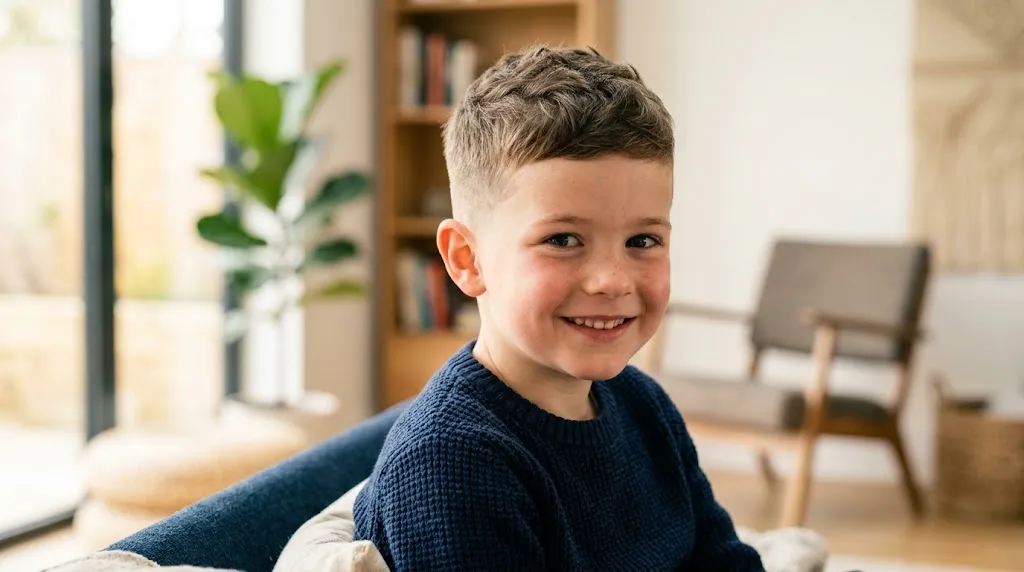
Wondering how to give your child a modern, trendy haircut without spending twenty minutes styling it every morning? The textured crop features closely clipped sides with short, soft layers on top that fall naturally forward into a blunt or piecey fringe. It is ideal for thick straight or wavy hair, maintaining its shape for four to six weeks as it grows. Avoid using heavy pomades or thick waxes, which weigh down small hair follicles and make young hair look greasy by lunchtime.
Ask the stylist for a short taper or fade on the sides with point-cut, textured layers on top.
Dampen the top layers slightly with water after morning washing.
Rub a pea-sized dot of lightweight matte cream between your palms and rake your fingers forward through the top hair.
To keep your morning painless, stick to a 30-second styling routine: damp the top, run your fingers forward, and pinch a few front pieces to create a quick, piecey texture. Popular spin-offs of this style include the classic Spiky Cut, the neat French Crop, a Messy Textured Crop, or a sharp Skin Fade Crop.
Low Taper Fade
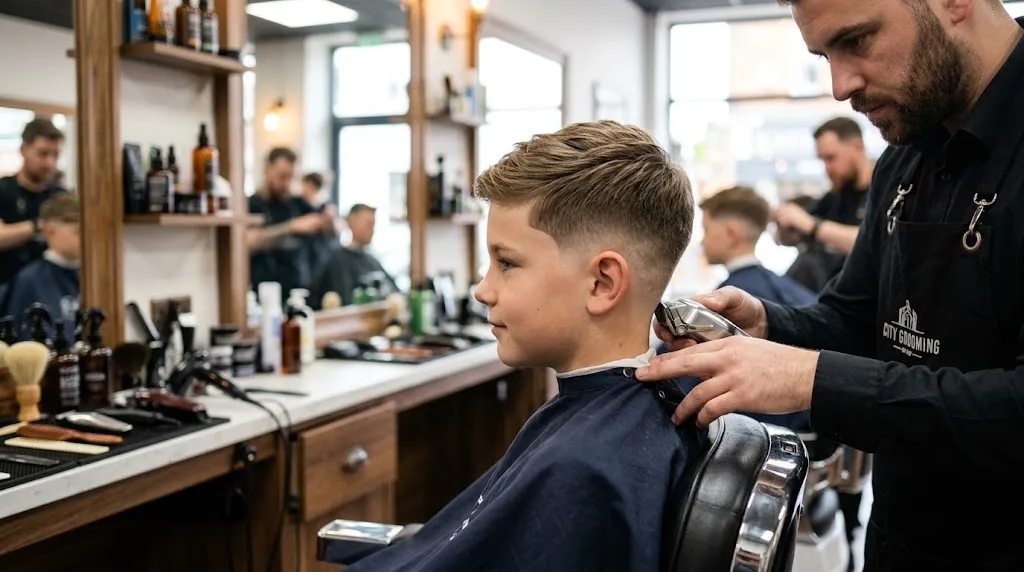
Many parents assume that a fade haircut requires high-maintenance styling, but a low taper fade actually keeps a kid looking sharp with zero morning fuss. This cut gradually shortens the hair around the hairline, temple, and nape while leaving the main length on top intact. It suits every hair type and stays clean for about two to three weeks before needing a line-up. Avoid taking a noise-sensitive child to a loud, busy shop without preparing them for the buzzing sound and vibration of the clippers.
Tell the barber you want a low taper, specifying where you want the fading to start near the ears and neck.
Decide on the top length, whether you want to keep it long enough to comb or short and textured.
Confirm if you want a squared, rounded, or natural neckline finish.
To make the visit sensory-friendly, schedule an appointment during quiet mid-morning hours, bring noise-canceling headphones, and ask the barber to let your child feel the clipper vibration on their hand before starting. This cut opens up endless choices, including the Mid Fade, High Fade, Taper Fade, Fade with Design, Fades and Braids, Burst Fade Mohawk, Tapered Afro Fade, or a sharp Undercut for Kids.
Side Part
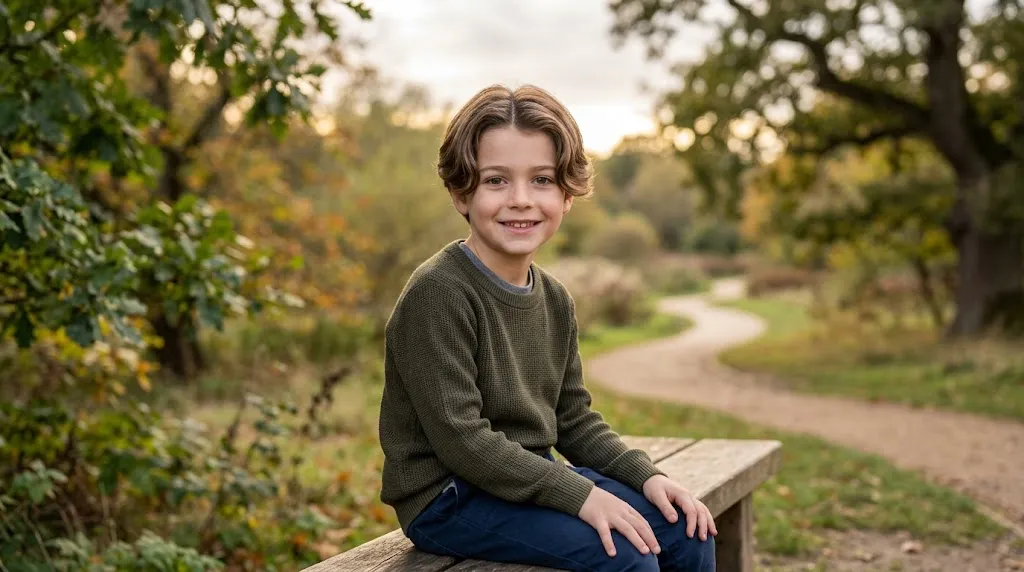
A side part is a classic, smart haircut where the hair is neatly divided along its natural parting line and swept across the head. It works best on straight to wavy hair textures and holds up reliably through a full school day. The main issue to avoid is applying stiff, high-hold gel, which hardens into a crispy shell and flakes off when your child plays outdoors.
Locate the natural part on damp hair by combing everything backward and seeing where it naturally splits over the eyebrow.
Draw a straight line from front to back using a fine-tooth comb.
Smooth the hair down and away from the part line using a tiny dab of light grooming cream.
For picture day, secure the comb-over with a mist of light water and set the shape with a soft-bristle brush so it stays smooth without feeling crunchy. You can adapt this traditional style into a modern Comb Over, a lifted Quiff, a structured Pompadour, or a smooth Slick Back depending on the occasion.
Curtain Bangs and Middle Part
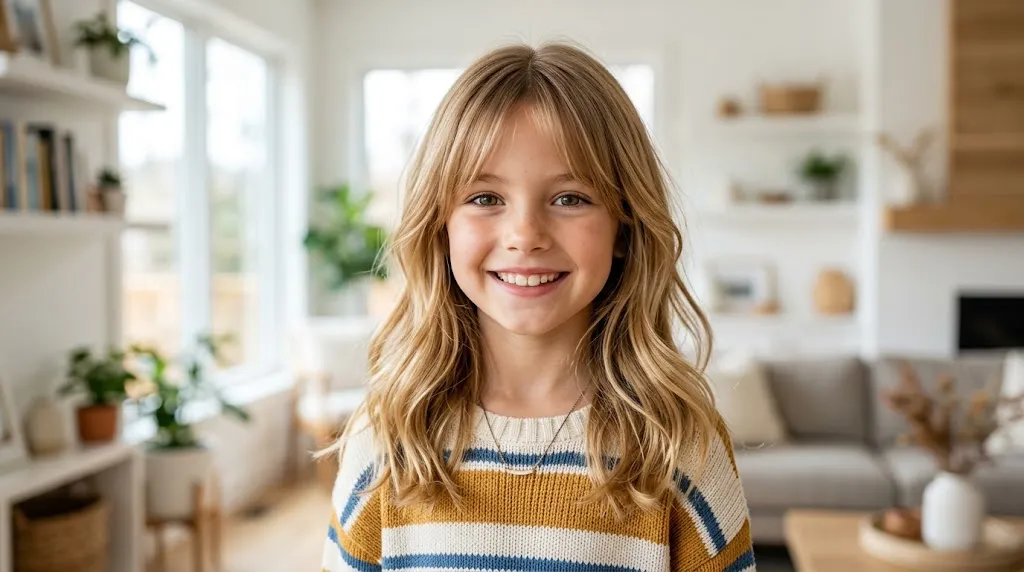
While traditional side parts offer a structured look, curtain bangs with a middle part bring a softer, 90s-inspired frame to the face. This style features medium-length hair parted down the center, allowing long fringe to sweep outward toward the cheekbones. It is best suited for straight or slightly wavy fine hair, lasting six to eight weeks between trims. Avoid letting the front lengths drop past the eyebrows without a trim, as falling hair causes eye strain and habit-taking face touching during class.
Request a center-parted cut with long, face-framing layers that taper toward the ears.
Towel-dry damp hair and comb it straight back over the center of the head.
Use your fingers to nudge the front hair forward and outward into a soft “curtain” curve as it air-dries.
To manage the grow-out phase while adhering to school dress codes, use a light sweep of leave-in conditioner to tuck the front pieces neatly behind the ears during study time. Similar mid-length variations include the Mushroom Cut, Two-Block, Dandy Cut, Comma Hair, see-through bangs, and the retro Bowl Cut. Our Korean boy hairstyle guide explains two-block, curtain and comma styles in detail for older boys and tweens looking for current East Asian styling trends.
Kids Mullet
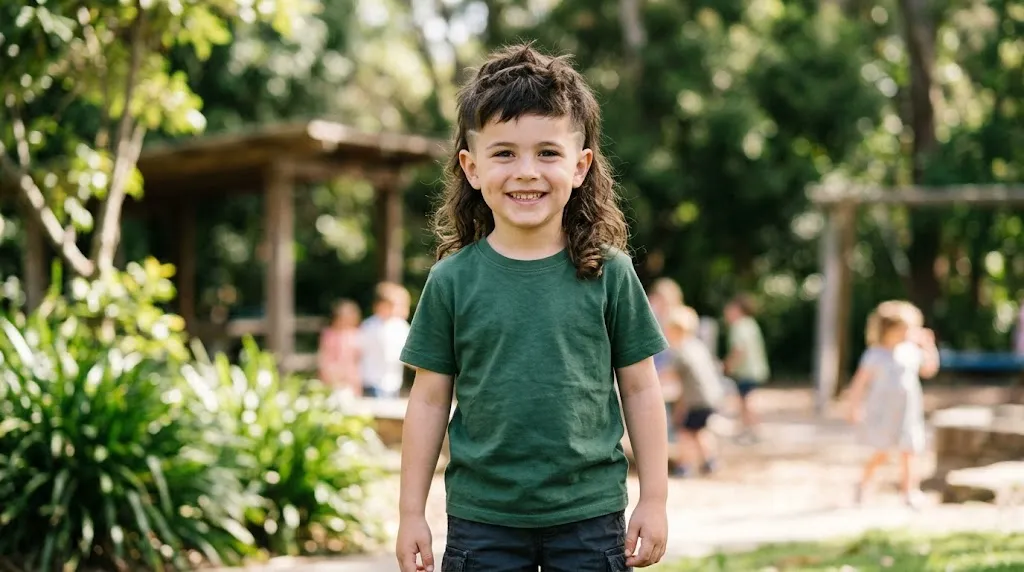
Picture a energetic kid running across the playground with a short, neat top and a playful flow of length brushing the back of his neck. The modern kids mullet keeps the front and sides tailored while leaving the back noticeably longer for a bold, expressive style. It accommodates straight, wavy, or curly hair textures well, growing out smoothly over two to three months. The primary pitfall is ignoring your school’s dress code policy regarding hair length over the collar.
Show the stylist three distinct photos showing your preferred length for the front, the sides, and the back flow.
Ask for a soft blend between the short top layers and the longer back section.
Keep the hair around the ears clear so the cut remains comfortable and tidy.
If you need a school-appropriate version, request a “soft mullet,” which keeps the length difference subtle—just long enough at the nape to show texture without extending far down the neck. The neat Short Mullet variation offers a great entry point for kids trying the trend for the first time.
Curly Fringe with Low Fade
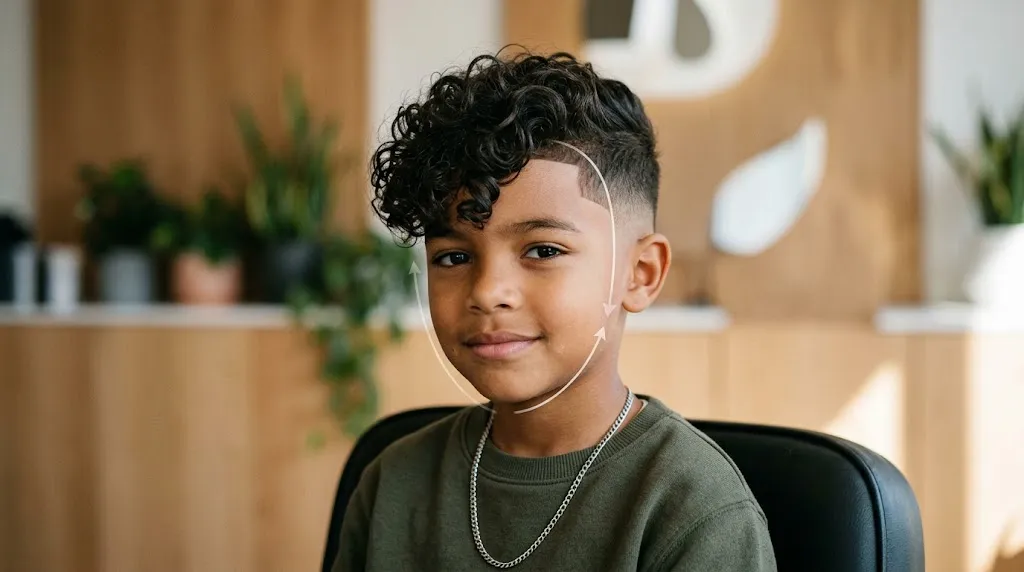
A curly fringe with a low fade combines neat, short sides with full, natural curls bouncing forward over the forehead. This style is built specifically for curly and coily hair types, providing clean structure while showcasing natural curl patterns. It holds up well for three to five weeks before the faded sides lose their crispness. Avoid letting a stylist cut curly hair wet without consulting you first; “Cutting curls while dry reveals their true length and bounce, preventing unexpected shrinkage once the hair dries.”
Ask the barber to fade the sides low while leaving two to three inches of volume on top.
Request hand-pruning on the top curls to preserve their individual coil shape.
Leave the front fringe slightly longer to fall naturally near the brows.
Build a simple wash-day routine: wash with a sulfate-free cleanser, rake a hydrating leave-in conditioner through wet curls with your fingers, and allow the hair to air-dry completely without brushing.
Wolf Cut and Surfer Style
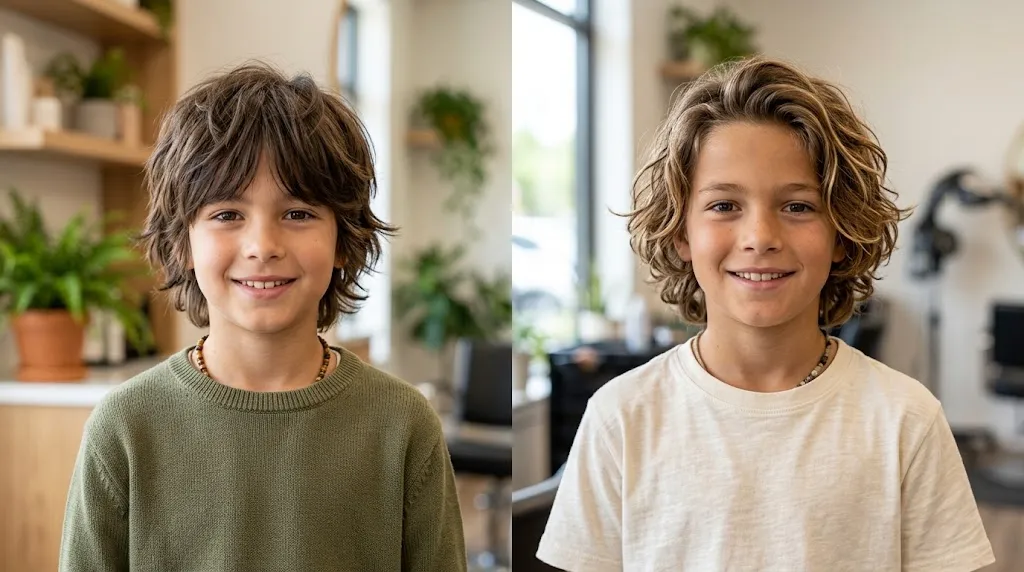
Is your child asking to grow their hair out, but you want to avoid a wild, unkempt look? The wolf cut and surfer style deliver a shaggy, heavily layered look that channels natural movement and volume. It works best on wavy hair or straight hair with medium density, lasting several months as a long-term grow-out option. Avoid cutting the top layers too short, which causes the crown to puff up into an unwanted bubble shape.
Ask the stylist for long, razor-cut or point-cut layers throughout the interior while maintaining perimeter length.
Ensure the front layers are shaped around the cheekbones to keep the eyes clear.
Scrunch a small amount of sea salt spray into damp hair to bring out wave patterns.
To keep long layers school-friendly, instruct the stylist to keep the hair around the face short enough to tuck behind the ears during writing tasks. Kids with straight hair can achieve a similar wavy shape through a soft Korean Kids Perm.
Faux Hawk and Mohawk
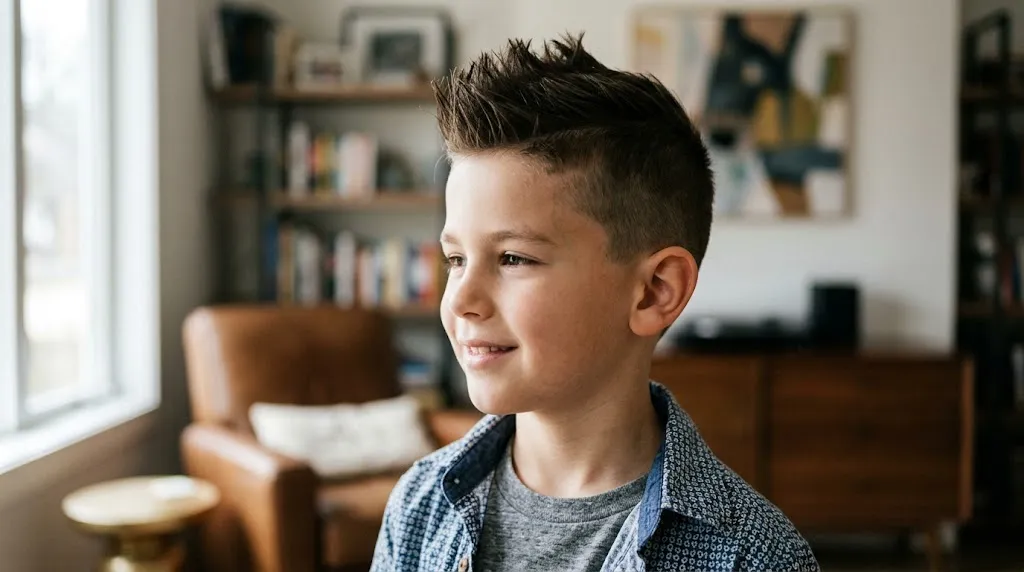
A faux hawk offers a fun, sporty look where hair in the center of the head is styled upward into a ridge while the sides remain short or faded. It works exceptionally well on thick, straight hair that naturally stands up. The style grows out cleanly over three to four weeks. Avoid using harsh, alcohol-based hair gels on young children, as these dry out the scalp and cause itching.
Tell the barber how wide you want the center strip to be, usually two to three inches across the crown.
Choose a taper or fade level for the sides.
Towel-dry hair, apply a dime-sized amount of child-safe styling paste to your palms, and press the center hair upward together.
For everyday school wear, gently comb the center top forward like a short crop; when weekend sports or birthday parties roll around, use a damp comb and matte paste to push the center strip up into a full hawk. You can also explore variations like the subtle Fohawk or the bolder Mohawk Fade.
Hair Colour and Accessories for Kids
Pop of Color
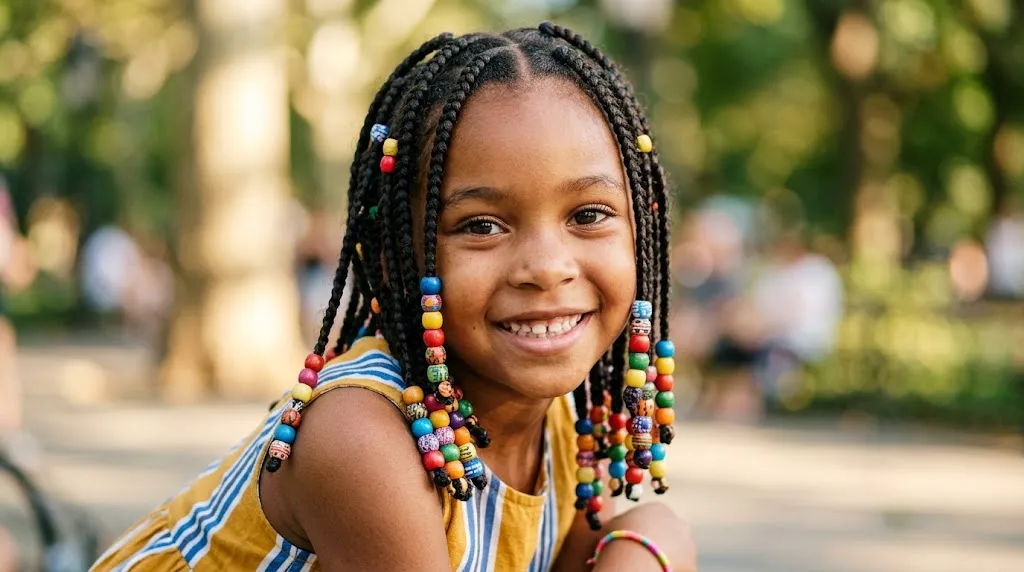
Are you wondering how to safely give your child the vibrant hair accents they keep asking for? A temporary splash of color—like bright face-framing strands or vivid pink curls—lets kids express their personality without committing to a permanent change. This fun, low-risk update works best for tweens and older children who can sit still during application and take care of their hair afterward.
Sit down with your child to review school dress codes and choose a temporary product.
Apply hair chalk, a colored wax, or a wash-out spray directly to specific sections like the front strands or curl tips.
Allow the product to dry completely, then gently comb through to separate the hair.
Wash the product out with a gentle shampoo before bedtime to avoid staining pillowcases.
Temporary options like chalks, sprays, and color-depositing conditioners rinse out in one to three washes. Semi-permanent dyes can last anywhere from two to six weeks, depending on how often your child washes their hair. Never use permanent hair color or bleach on young children without consulting a pediatric dermatologist or a professional hair stylist Chemical safety guidelines for prepubescent hair]. Before applying any color, always get your child’s enthusiastic consent and double-check your school’s guidelines on unnatural hair shades. Popular accent variations include Colorful Highlights, Glowing Highlights, and Fun Pink Curls.
Hair Accessories for Kids: Types and Safety
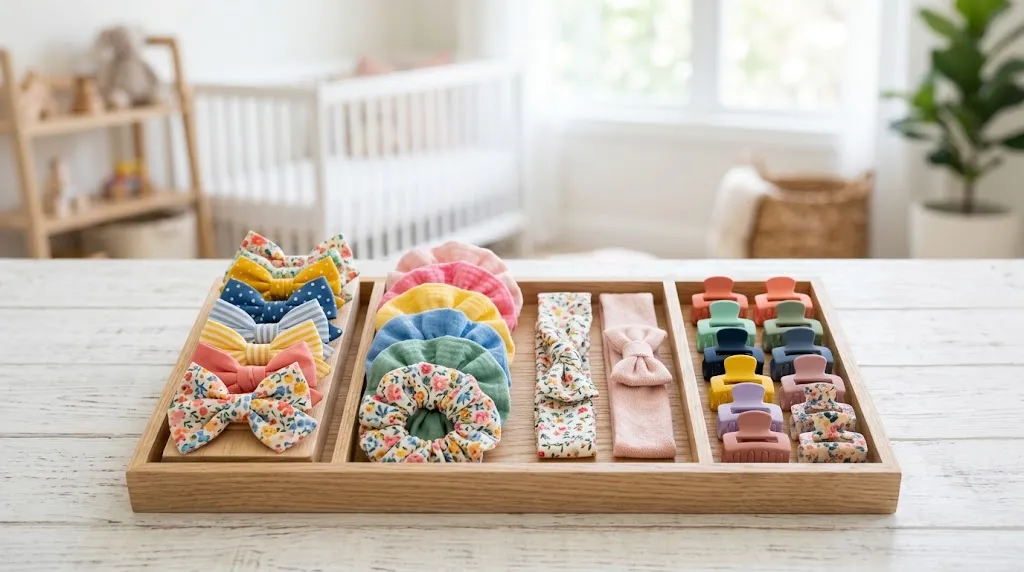
Hair accessories add quick flair and functional hold to any everyday haircut or special-occasion style. You can easily elevate a simple ponytail, braid, or loose look using soft fabric scrunchies, mini claw clips, statement bows, nostalgic butterfly clips, hair beads, dreadlocks cuffs, wrapped colored threads, or regal gold and crown-style headbands.
When choosing accessories for babies and toddlers, prioritize safety above all else. Small items like beads, mini clips, clear elastics, and metal cuffs present a serious choking hazard if they slide out or get pulled free. Always inspect clips for loose decorative pearls or sharp metal edges, and remove all hair accessories before naptime, bedtime, or unsupervised play in the car. Soft, snag-free fabric headbands and oversized fabric scrunchies are the safest options for younger children.
Occasion Hairstyles for Children
Special events require styles that hold up through long hours of movement, photo sessions, and schedule shifts. Preparing a child’s hair for a wedding, picture day, or holiday gathering works best when you choose a style suited to the event’s duration and match it with a realistic prep timeline.
Wedding and Flower Girl Hairstyles
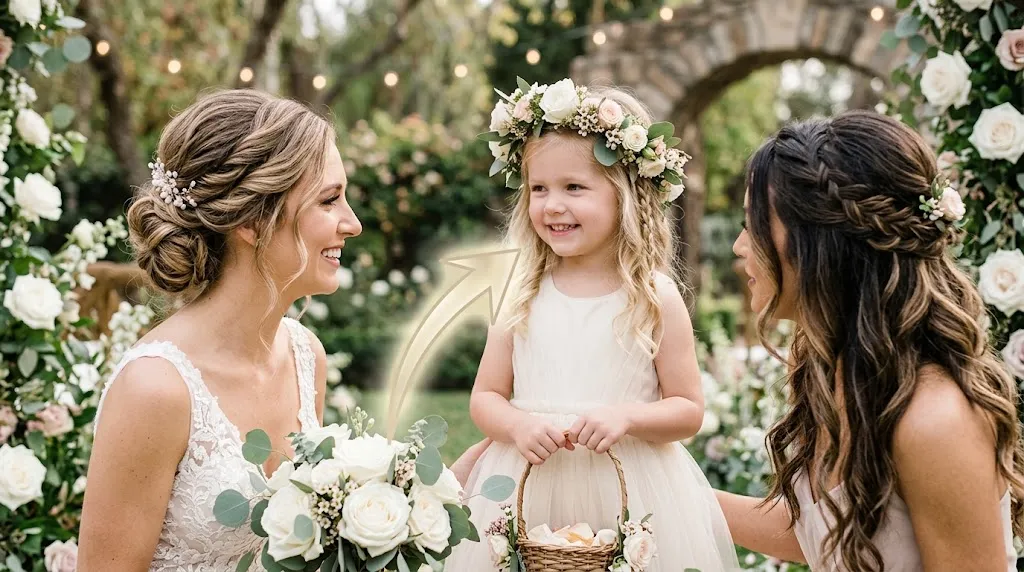
Formal events like weddings demand maximum hold without pulling too tightly on sensitive scalps. For girls, reliable options include the Braided Bun, Heart Braids, Bow Top Bun, or a soft Curly Half-Up, Half-Down. For boys, a neat, formal side part creates a clean silhouette that stays sharp in photos.
To keep the morning stress-free and ensure the style lasts through the reception, follow this timeline:
Two days before: Wash hair thoroughly so natural oils build up slightly, giving elastics and pins better grip than slick, freshly washed hair.
Morning of the event (2 hours before leaving): Apply a light leave-in conditioner or styling cream, create your sections, and execute the base style.
30 minutes before leaving: Secure any decorative accessories, such as ribbon loops, floral pins, or mini hair rings, placing them securely away from the face.
Right before photos: Perform a hold check by running a soft-bristle brush over flyaways with a touch of light-hold hairspray or edge control.
Avoid placing metal bobby pins directly against the scalp or pulling hairline edges taut to prevent traction discomfort while the child sits through the ceremony.
Picture Day, Birthday and Holiday Photos
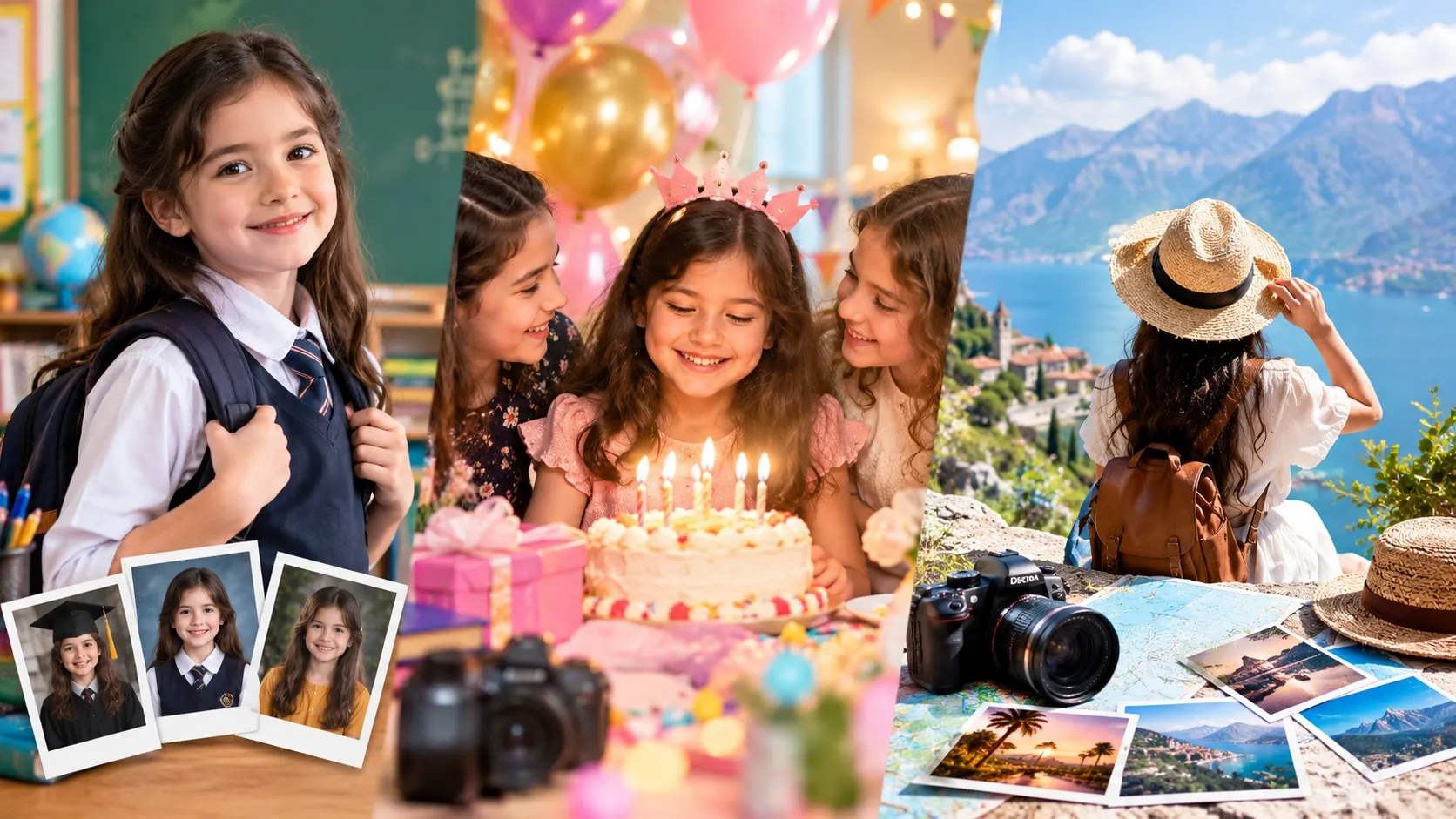
Photo sessions capture fine details, making hair symmetry, neat parts, and controlled flyaways more important than complex volume. Top choices that photograph exceptionally well include a crisp Side Part, high Pigtails, a smooth Bubble Ponytail, or a subtle Pop of Color using clip-in tinsel or bright ribbons.
When preparing a child for photos, avoid getting a fresh haircut or trim on the morning of the shoot. Freshly cut ends can look unusually sharp on camera, and any accidental line slips leave no time for adjustment. Instead, schedule hair trims 5 to 7 days in advance so the hair settles naturally.
To ensure the style looks clean on camera:
Keep hair off the shoulders if the outfit features an ornate collar or neckline.
Use a tiny amount of pomade or hair wax on a clean spoolie brush to smooth down fine baby hairs around the face.
Avoid heavy, greasy oils or heavy sprays that can make hair look shiny or flat under studio flash units.
Hairstyles by Age: Toddlers to Tweens
Selecting the right haircut or style changes dramatically as a child grows from a fidgety toddler into a tween who wants full say over their look. Hair texture, daily routine, and how long a child can sit still dictate which styles actually work for each developmental stage.
Good Hairstyles for 7-Year-Old Kids
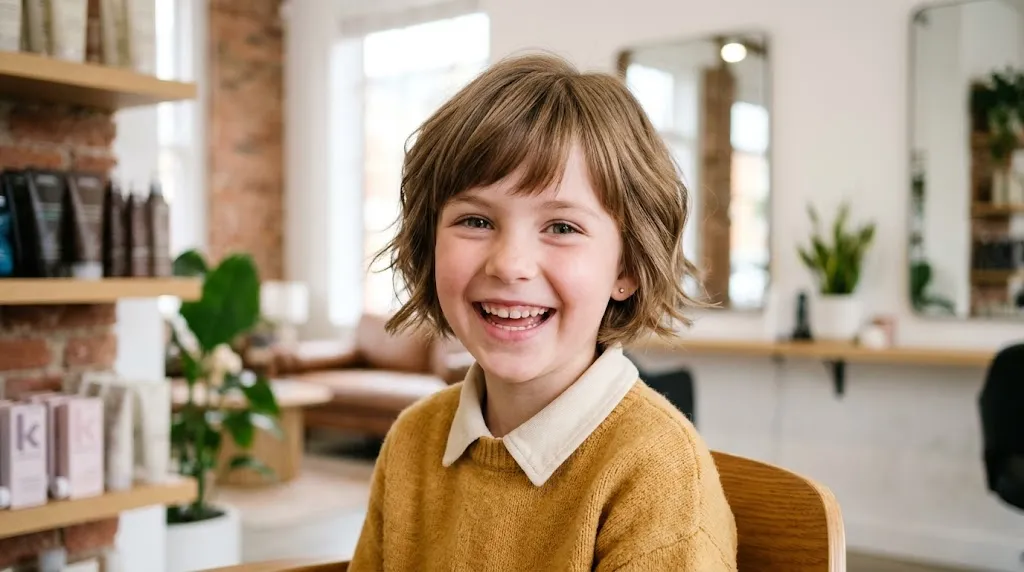
Picture a typical 7-year-old school morning: breakfast is running late, the bus is coming in ten minutes, and their hair needs to survive both morning reading and afternoon recess. At age seven, kids need hairstyles that balance independence with durability so they look tidy all day without constant touch-ups.
School mornings: A classic bob, a neat high ponytail, or a layered short crop. These allow seven-year-olds to brush their own hair in the morning while keeping strands clear of their eyes during writing and art classes.
Sports and active play: Braided pigtails, a high bun with a secure fabric scrunchie, or an undercut crop. These choices hold tight through physical education class, soccer practice, and monkey bar sessions without slipping loose.
Parties and special occasions: Half-up twists, a sleek side part with lightweight pomade, or soft accent braids. These styles elevate the child’s daily cut without requiring heavy styling products or lengthy prep time.
What Is the Best Haircut for a 7-Year-Old Girl?
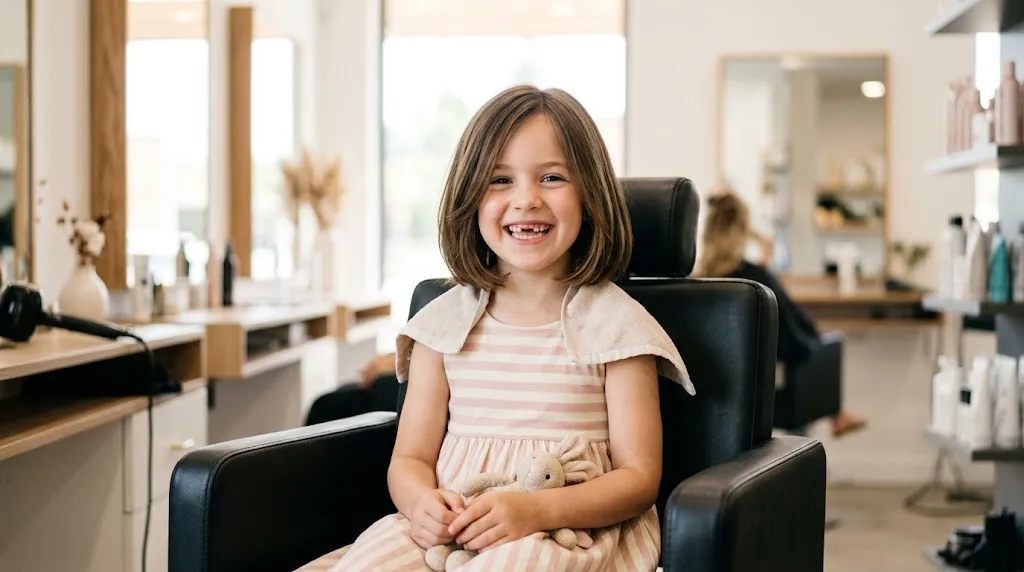
The best overall haircut for a seven-year-old girl is a shoulder-length medium bob with subtle internal layering. This length is long enough to pull back into a ponytail for gym class, yet short enough that routine brushing takes under two minutes every morning.
For girls with fine or straight hair who want zero morning fuss, a jaw-length blunt bob is an ideal alternative because it resists tangling and holds its shape with simple air-drying. If a child has natural curls or thick wave patterns, a long-layered cut extending past the shoulders provides enough weight to prevent excess volume at the sides, making it much easier for a seven-year-old to brush and maintain independently.
Your Child’s First Haircut
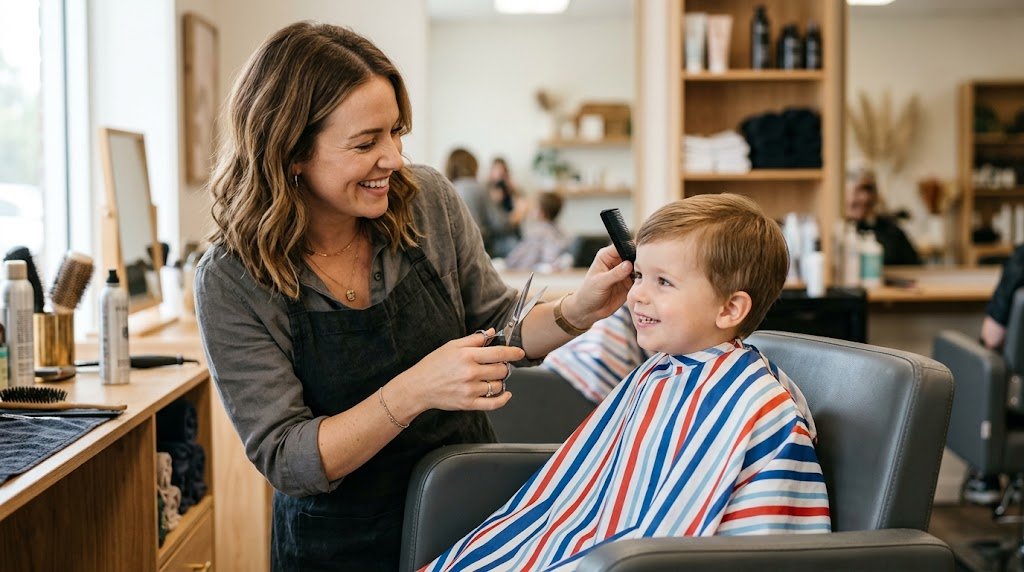
A child’s first haircut sets the tone for future salon visits, making preparation and timing much more important than achieving a complex style. Schedule the appointment during mid-morning when your child is well-fed and rested, avoiding times that overlap with naps or meals.
Before heading to the salon, prepare your child by talking through what will happen in plain, comforting terms. Avoid using words like “cut” or “scissors” if they trigger fear; instead, explain that the stylist will “trim” or “tickle” their hair. Bringing a favorite comfort item, a secondary shirt in case hair falls inside the collar, and a familiar video on a phone can provide an effective distraction while the stylist works.
When speaking to the child’s stylist, ask for a gentle dry trim or a simple blunt outline that works with their natural growth pattern and whorls. Request that the stylist show the tools to your child before starting and avoid using high-pitched clippers near a sensitive toddler’s ears.
Toddler and Preschool Hairstyles (Ages 1-5)
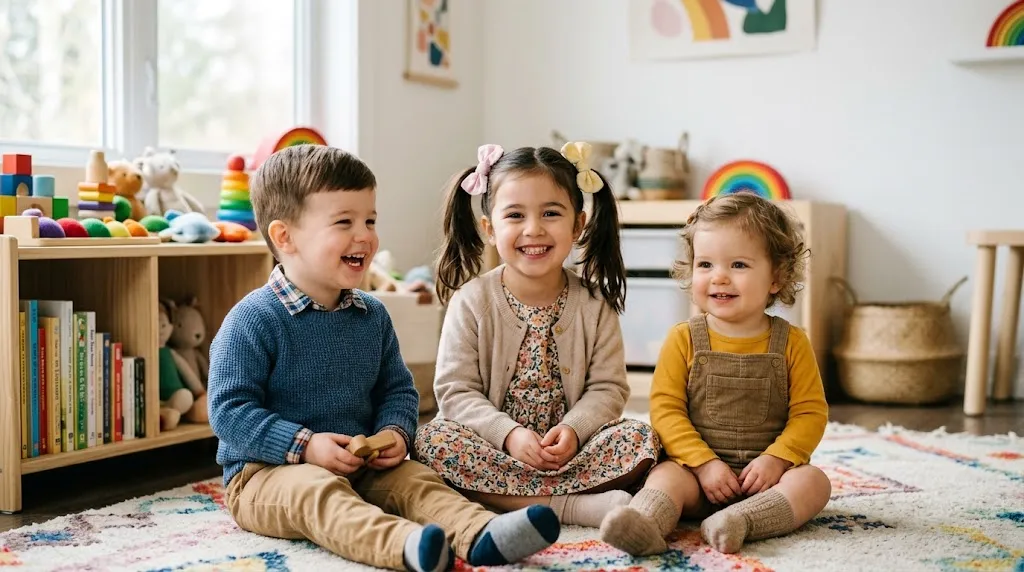
Styling hair for toddlers and preschoolers requires matching the chosen look to how long the child can sit comfortably without squirming. For very young toddlers with fine baby hair, gentle handling is essential—never pull hair tight or force elastic bands onto thin, developing hairlines.
Under 2 minutes of patience: Natural baby curls left loose with a light leave-in conditioner, or a single soft fabric clip to hold wisps out of the eyes.
3 to 5 minutes of patience: A soft top-knot secured with a mini fabric scrunchie, twin high pigtails using seamless cloth ties, or a quick side-swept fringe clip.
5+ minutes of patience: Mini cornrows, soft crown braids, or a clean low fade with a combed top for short hair.
When styling natural baby hair, use your fingers or a soft-bristle brush along with a gentle water-based detangling spray. Avoid rubber elastic bands, hard plastic combs, or tight tension that can cause traction stress on a toddler’s delicate scalp and hairline.
Hairstyles for Tweens (Ages 9-12)
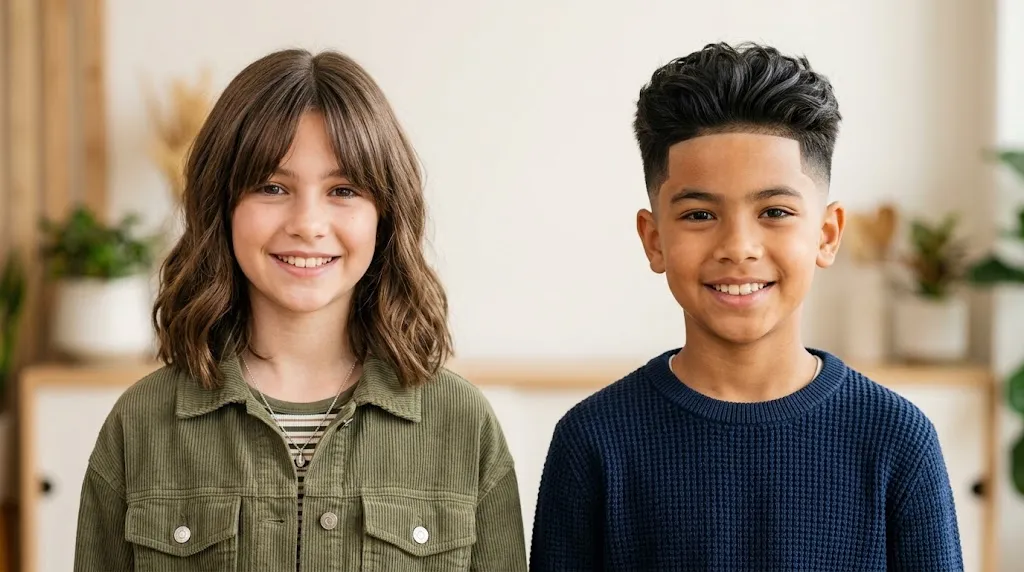
By age nine to twelve, children enter a phase where personal identity takes center stage, and they expect to choose their own hairstyles. Your role shifts from deciding the style to helping your tween navigate the balance between personal self-expression, daily hair care responsibility, and school dress code policies.
Tweens often draw inspiration from trends they see online, in media, or among classmates, ranging from soft curtains bangs and face-framing layers to textured buzz cuts and sharp fades. Work with your tween to review their chosen look against school rules regarding line-outs, hair length, or color treatments. If an older boy or tween is interested in modern layered or textured fringe styles, check out our Korean-style haircut guide for detailed inspiration on tailored cuts.
Style Finder by Age, Hair Type and Time
| Age Group | Hair Type | Time Available | Recommended Style Pick |
|---|---|---|---|
| Toddler (1–4) | Fine / Straight | Under 2 mins | Soft side-clip or natural air-dry |
| Toddler (1–4) | Curly / Coily | 3–5 mins | Pineapple top-knot with fabric scrunchie |
| School-Age (5–8) | Medium / Wavy | 5 mins | Half-up twist or classic low ponytail |
| School-Age (5–8) | Thick / Any | Under 2 mins | Jaw-length bob or short textured crop |
| Tween (9–12) | Any | 5–10 mins | Face-framing layers or textured fringe fade |
Which Face Shape Suits Which Light Curl Style
Round Face
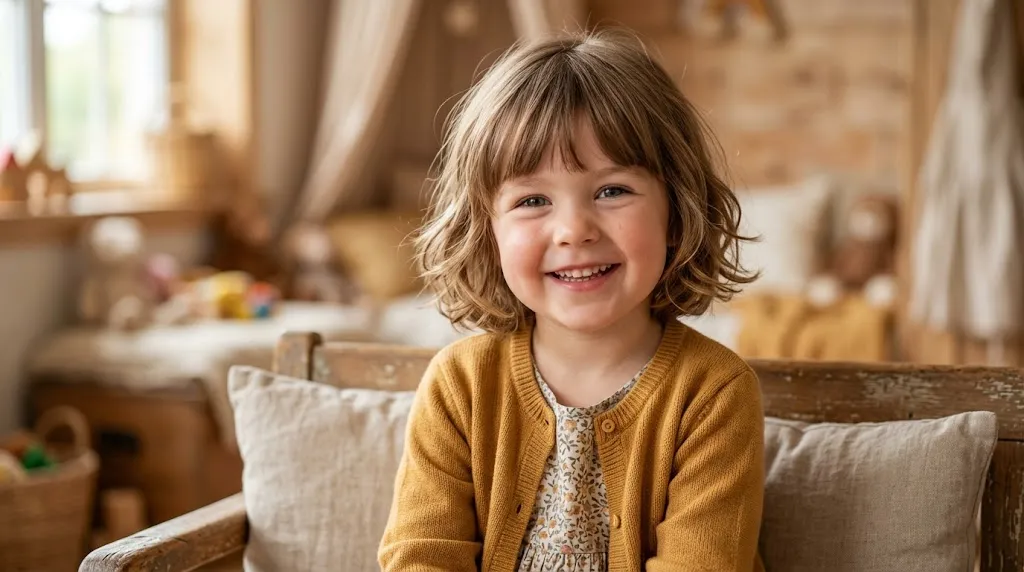
To counteract the width of a round face, light curls need to add vertical lift and elongate your silhouette rather than puffing outward at the cheeks. Keep the volume concentrated at the crown while letting looser, elongated waves drape past the jawline or collarbone. Avoid tight, shoulder-length spirals that sit right at the widest part of your face, as they only add horizontal bulk. Instead, opt for a cut with longer layers, like those detailed in our guide on the best round shape haircuts, which creates natural downward lines that instantly slim and balance soft features.
Oval, Heart & Square Face
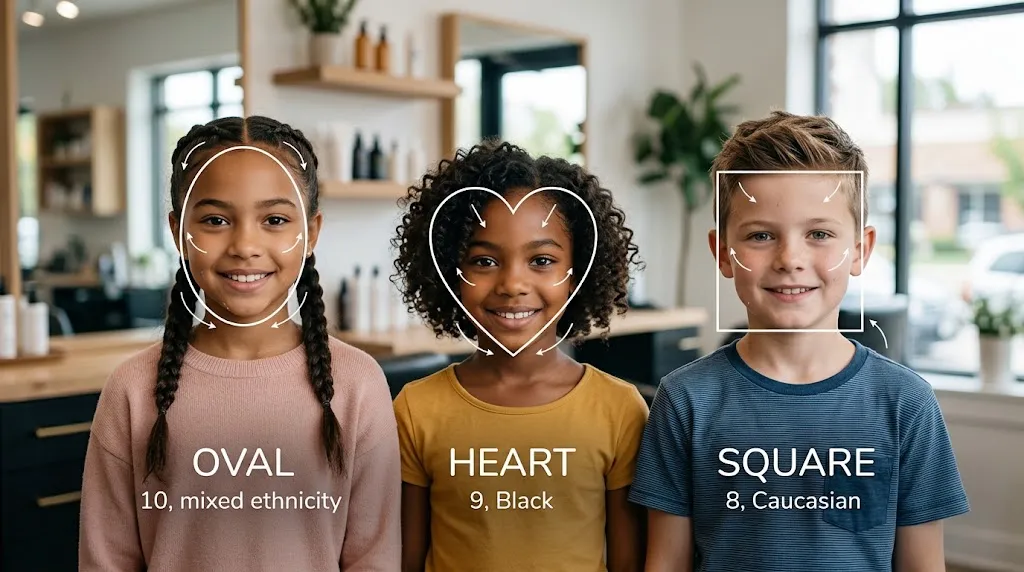
Balancing angular or elongated bone structures comes down to strategic placement and soft framing. Oval faces can wear almost any curl pattern, but loose, collarbone-grazing waves preserve natural symmetry without overwhelming the features. Heart-shaped faces benefit from curls that start around the chin to fill out a narrower jawline, often paired with a soft side-swept fringe. Square and heavily angular faces require texture that diffuses strong jawlines. Soft, airy waves breaking right at the jaw or slightly below soften hard edges, much like the precision styling methods discussed for achieving a slim face haircut, which neutralizes heavy angles by introducing fluid, circular movement around the perimeter.
Children Hairstyles for School: What Holds Through the Day
| Style Type | Prep Time | School Rule Compliance | Hold Time |
|---|---|---|---|
| High Ponytail | 2 minutes | High (keeps hair out of eyes) | Loose by mid-afternoon on fine hair |
| Dutch Braids | 8–10 minutes | High (secures flyaways completely) | All-day hold (8–12 hours through active play) |
| Classic Crew Cut | 0 minutes | Maximum (meets strict hair codes) | Outgrows in 3–4 weeks |
| Half-Up Topknot | 3 minutes | Moderate (check rules on hair length below ears) | Holds 4–6 hours before sagging |
Simple Children Hairstyles For School Girls
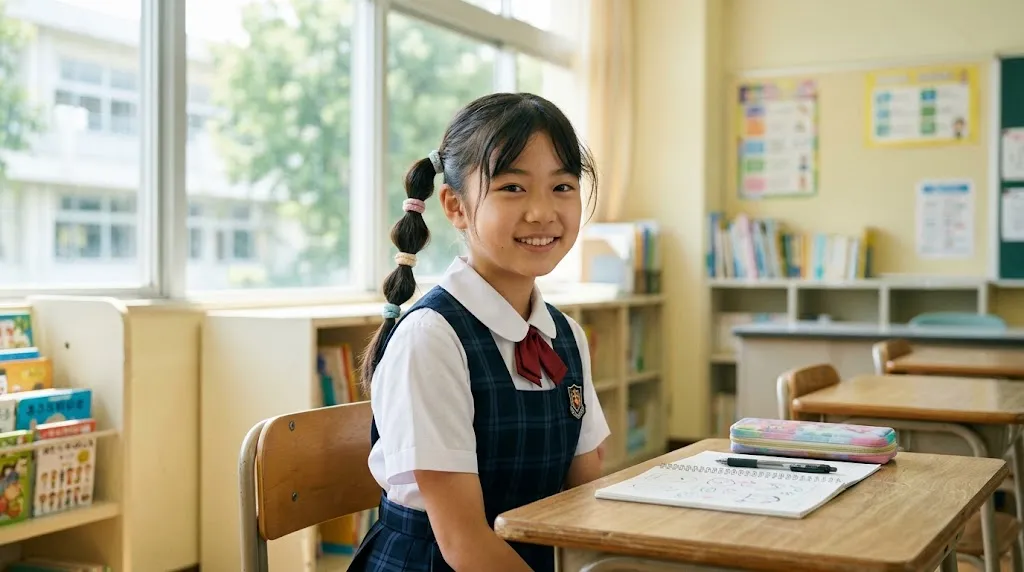
The best simple school styles for girls are those that secure the front fringe area while remaining comfortable during desk work and active play. Here is a ranked list of quick options ordered by ease of execution and durability:
Double Dutch Braids: The highest-rated style for active days because it weaves hair tightly along the scalp, preventing flyaways during gym class.
Low Side Braid: Ideal for long or thick hair, this quick style keeps strands off the neck without pressing against the back of a desk chair.
Pigtail Twists: A simpler alternative to three-strand braids that works exceptionally well on medium-length hair and takes under three minutes.
Bubble Ponytails: Uses multiple soft elastics down the length of a standard ponytail to keep fine hair from slipping out throughout the day.
Half-Up Claw Clip Style: Best for older girls and tweens who want a quick, stylish look that keeps front layers out of their face.
School Haircuts for Boys
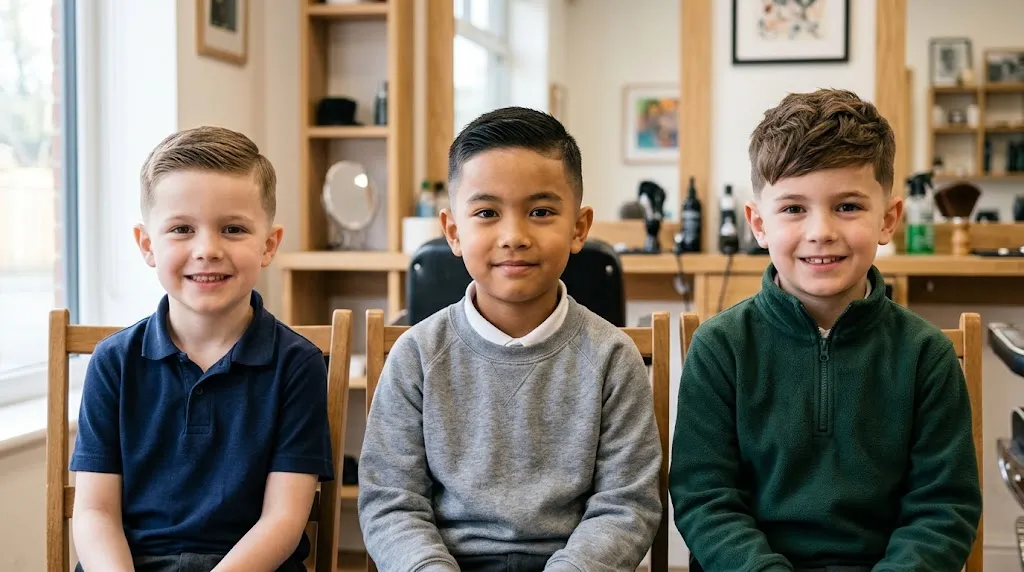
School-friendly haircuts for boys range from traditional neat cuts to modern textured styles that fit standard dress codes while requiring minimal morning effort. You can browse our full collection of boys’ hairstyle photos for additional visual inspiration before visiting the barber.
Classic Crew Cut: Top-ranked for dress-code compliance and zero morning styling, though it requires a trim every 3 to 4 weeks to maintain its shape.
Ivy League Cut: Slightly longer on top than a crew cut, allowing side-parting for formal school events while staying neat for daily wear.
Short Taper Fade: Keeps the sides and back clean and above the collar while leaving enough length on top to style with a dab of light pomade.
Textured Crop: Works well with natural hair texture or waves, keeping length short enough to avoid dress-code warnings while hiding bedhead.
School Hair Rules to Check Before Styling
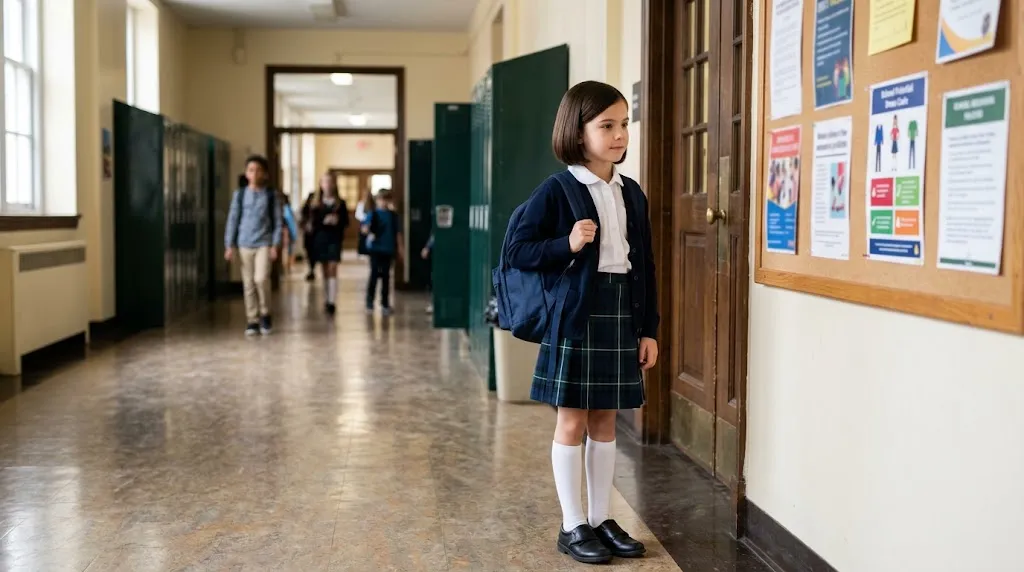
School dress codes vary widely, and checking your school’s specific hair policy at the start of the year prevents unnecessary morning adjustments or calls home. Review these four key areas before trying a new cut or style:
Hair Color and Dye: Many schools prohibit bright unnatural shades (like blue, pink, or green) or high-contrast temporary hair chalks.
Extreme Cuts and Designs: Check policies regarding shaved patterns, zig-zag lines, step fades, or exaggerated mohawks before taking your child to the barber.
Hair Accessories and Beads: Ensure hard plastic beads, large bows, or metal clips are allowed, as some schools restrict them due to safety concerns during physical education.
Hair Length and Eyes: Most policies require hair to stay clear of the eyes and off the collar for boys, or tied back safely for science labs and gym activities.
Summer and Active-Day Hairstyles for Kids

Hot weather, summer sports, and pool days call for styles that stay secure, protect hair from damage, and keep strands off sweat-prone necks. Choosing the right cut or updos for heat helps children play comfortably without hair falling into their face every few minutes. The key is balancing a firm, comfortable hold with quick, gentle prep that prevents severe tangles later in the day.
Pool and Beach Day Hairstyles
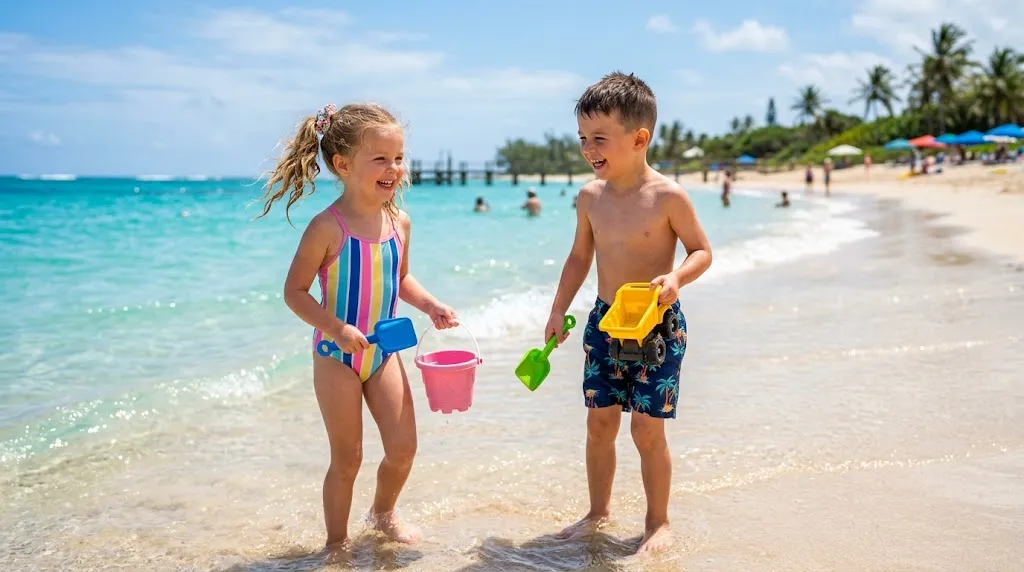
For swimming and beach trips, the best styles to keep hair manageable and tangle-free are French Braids, Bubble Ponytails, and classic Pigtails. These options secure strands close to the head so water and wind cannot whip them into tight knots. Before jumping in, soak the hair thoroughly with clean tap water and coat it with a leave-in conditioner or hair oil. This prevents the hair shaft from absorbing excess chlorine or salt water. Right after swimming, rinse the hair with fresh water immediately, gently untangle with a wide-tooth comb starting from the ends, and reapply a lightweight leave-in conditioner.
Staying Cool: Short Cuts and Updos
Picture a humid July afternoon at the playground where a child is constantly pushing sweaty hair off their forehead and neck. Switching to high-positioned updos or low-maintenance short cuts instantly relieves that heat. High topknots, double crown braids, and short buzz or pixie cuts lift length completely off the nape of the neck, where sweat accumulates fastest. For active kids with longer hair, securing a topknot with a soft fabric scrunchie rather than an elastic band prevents breakage around the hairline while keeping them cool all afternoon.
Common Kids’ Hair Problems and How to Fix Them
Hair struggles often turn morning routines into stressful battles before school even starts. Getting past daily hair drama comes down to using the right mechanical techniques, proper tools, and gentle communication rather than forcing hair into submission.
Hair That Won’t Stay Up
Fine or slippery hair slides out of standard elastics because the hair shafts lack enough natural texture to create friction against smooth materials. To lock styles in place, start by spraying a tiny mist of dry shampoo or texturizing spray onto the hair before gathering it, which gives the elastic something to grip.
Clean and dampen the section of hair slightly to remove surface slip.
Wrap a silicone or cloth-covered elastic tightly around the section.
Lightly mist the base with a mild hold hairspray or working spray.
Secure troublesome flyaways by crossing two small bobby pins in an “X” shape over the band.
Avoid pulling elastics too tight to compensate for slipping, as extreme tension can damage delicate hair shafts or cause traction discomfort.
Tangles and a Tender-Headed Child
Detangling without tears requires working from the bottom up to release knots without pulling directly against the sensitive hair follicles on the scalp. Always apply a generous layer of leave-in detangling spray or conditioner to dry or damp hair before touching it with a comb.
Separate the hair into four manageable quadrants using soft sectioning clips.
Firmly hold a section near the mid-shaft with one hand to absorb any pulling force.
Begin combing the bottom two inches using a wide-tooth comb or flexible detangling brush.
Work upward toward the roots in small two-inch increments once the ends are completely smooth.
Never drag a fine-toothed comb downward from the roots through tangled hair, which tightens knots and snaps fragile ends.
Cowlicks and Bangs That Stick Up
A cowlick is a section of hair that grows in a strong spiral or directional pattern different from the rest of the head. When cutting or styling bangs over a cowlick, ask your stylist to leave the front section slightly longer so the extra weight holds the hair down naturally.
Wet the cowlick section completely at the root using a spray bottle.
Place a fine-tooth comb at the base of the damp hair.
Blow-dry on medium heat while combing the hair firmly in the opposite direction of its natural growth.
Switch directions and comb it back across the other way until the root dries flat.
Avoid cutting bangs too short over an active frontal cowlick, as removing the weight causes the hair to spring straight upward.
Growing Out a Haircut Your Child Dislikes
An awkward grow-out phase can be managed by using simple transitional styles that hide uneven lengths while keeping hair off the face. Braiding the front sections along the hairline, sweeping short layers back into claw clips, or using soft fabric headbands neatly conceals short pieces that will not reach a ponytail.
Use mini claw clips to pin back unruly top layers along the crown.
Braid short side pieces into french braids that anchor firmly into a back pony or mini bun.
Incorporate soft fabric headbands with silicone grips to hold back short fringe.
Avoid trying to force short, uneven layers into tight, high ponytails with multiple rubber bands, which leads to breakage along the hairline.
A Child Who Refuses Every Style
Children often fight hair styling due to sensory overload from pulling, brush bristles on the scalp, or a feeling of losing control over their body. Giving children a choice in their accessories or letting them hold a handheld mirror during the process turns a forced routine into a collaborative activity.
Offer two pre-approved options, such as choosing between two ribbon colors or clip styles.
Use seamless fabric hair ties and wide, soft-bristled brushes to minimize scalp sensation.
Set a visual timer so the child knows exactly how long styling will last.
Perform hair care while the child sits on a comfortable low stool facing their favorite show or activity.
Never force a child through a painful or overwhelming styling session, as creating fear around hair care makes future visits to the salon far more difficult.
Practical Questions Before Your Salon Visit
Walking into a salon or barbershop with a child goes much smoother when you have a plan for communication, budget, and everyday maintenance. Parents often leave dissatisfied not because the stylist lacked skill, but because clear expectations were not set before the cape went on.
What to Tell the Stylist or Barber
Bring two or three reference photos showing the exact length and shape you want, and immediately show what you do not want. Photos prevent miscommunication because terms like “short trim” or “just a little off the top” mean vastly different things to different stylists.
A simple script you can use when sitting down in the chair:
“We want to keep [Length/Style], but it needs to stay out of their eyes for school. Please do not cut the top shorter than [Specific Length, e.g., two inches], and avoid taking the sides too high. Here are two photos of what we like, and here is one photo of what we definitely want to avoid.”
Be completely honest about your child’s morning routine and tolerance for styling. If you only have two minutes to comb their hair before the school bus arrives, tell the stylist so they do not give your child a high-maintenance cut that requires daily blow-drying or heavy pomade.
Salon vs Home: Cost and Time
Professional salon haircuts offer precise shaping, professional-grade blending, and a dedicated environment, while home haircuts save money and eliminate travel time. A salon visit typically takes 20 to 45 minutes, whereas cutting hair at home can take anywhere from 15 minutes to over an hour depending on your confidence level and the child’s willingness to sit still.
While cutting hair at home avoids recurring costs, it requires an initial investment in proper tools and carries a higher risk of uneven lines or visible mistakes. Salon cuts cost more per visit, but an experienced child stylist knows how to work quickly around a moving head while keeping the child safe and calm.
Basic Tools Parents Need
Maintaining children’s hair between salon visits or doing basic home styling requires only a few core tools designed to prevent pain and breakage. Investing in gentle, child-friendly hair equipment makes daily routines much faster and reduces morning tears.
Wide-tooth comb: Essential for gently working through wet hair and working out knots without snapping fragile strands.
Soft elastics: Fabric-covered or silicone bands that secure styles without catching, pulling, or creasing the hair shaft.
Detangling spray: A lightweight formula that adds slip to dry or damp hair, allowing combs to glide through tangles easily.
When purchasing hair tools online, some retailer links may earn us a small commission at no additional cost to you, which helps support our editorial testing.
Safety: How Tight Is Too Tight for Children’s Hair?
Children’s scalp skin is thinner and more sensitive than adult skin, making their hair follicles vulnerable to constant tension. Hair styles should never cause pain, redness, or headaches.
Health Disclaimer: This guidance is for informational purposes only and does not substitute for professional medical advice. Always consult a pediatric dermatologist or a qualified healthcare provider regarding scalp conditions or hair loss in children.
Warning Signs at the Hairline
Tension on the hair follicles creates noticeable signs along the hairline and scalp before permanent damage occurs. According to the American Academy of Dermatology, tight buns, ponytails, and up-dos can cause traction alopecia, a form of hair loss triggered by continuous pulling, and children are susceptible to it.
Look for these key warning signs during or after styling:
Small bumps or redness: Tiny pimple-like bumps appearing around the hairline, nape, or parts indicate stressed follicles.
Scalp tenderness or headaches: A child complaining of a tight scalp or a headache right after getting their hair done is experiencing unsafe tension.
Visible scalp strain: Skin around the forehead or temples that looks pulled taut, or eyebrows that appear slightly lifted, means the style is too tight.
Frying or broken hairs: Short, fuzzy broken strands along the hairline signal that hair shafts are snapping under pressure.
If you notice any of these signs, loosen or take down the hair style immediately to relieve tension on the root.
Safer Ways to Wear Braids, Buns and Ponytails
Protective and gathered styles can keep hair neat without damaging delicate roots if you adjust your technique and tools. According to clinical guidance from the Society for Pediatric Dermatology, low-hanging, loose ponytails and relaxed buns carry a much lower risk of tension-related damage compared to high, slicked-back styles.
To keep gathered styles safe and comfortable:
Switch to snag-free ties: Use fabric-covered elastics or soft scrunchies instead of bare rubber bands, which cut into the hair shaft and pull roots.
Position styles lower: Secure ponytails and buns near the nape of the neck rather than high on the crown to lessen gravity’s pull on the front hairline.
Leave room at the base: Allow about an inch of slack near the scalp when starting a braid or gathering a ponytail so the hair moves naturally when your child turns their head.
Limit wear duration: Remove braided styles within the maximum recommended timeframe—the AAD advises keeping braided styles in for no longer than two to three months, though younger children often need breaks much sooner.
Rotate daily styles: Avoid placing elastics in the exact same spot every day to prevent concentrated stress on specific hair strands.
Heat and Colour: What to Ask Before You Book
Chemical services and high-heat styling can permanently alter a child’s fine hair structure and irritate sensitive scalps. Before booking any appointment that involves heat or hair color, ask the stylist these practical questions to ensure your child’s comfort and safety:
“Is this service age-appropriate for my child’s hair texture?” Ensure the stylist works regularly with young children and understands how juvenile hair differs from adult hair.
“Will you do a strand and patch test first?” A patch test behind the ear checks for skin allergies, while a strand test reveals how fragile hair handles heat or dye.
“What heat setting will be used on the tools?” Heat tools used on children should remain below 300°F (148°C) to prevent thermal burning of the shaft.
“Are the products formulated without harsh chemicals?” Inquire about ammonia-free, gentle options or temporary non-permanent alternatives designed for sensitive skin.
“How long will my child need to sit in the chair?” Young children struggle to sit still for long periods, which increases the risk of accidental heat burns from hot tools.
Kids' Haircut & Care Questions
Practical guidance on school-day styling, preventing scalp strain, and maintaining healthy hair.
A low-maintenance school hairstyle keeps hair away from the face, requires minimal product, and holds through active play without frequent re-do's. For longer hair, simple styles like a low ponytail, quick three-strand braid, or a soft half-up twist are ideal because they take under two minutes and prevent tangles. For shorter hair, a clean crew cut, a textured crop, or a classic bob with a headband keeps styling time nearly zero while keeping hair neat all day.
Selecting the right style depends on working with your child's natural curl pattern and density rather than against it. Fine, straight hair stays neat in blunt bobs, pixies, or simple banded ponytails, whereas thick or coarse hair manages weight best through layered cuts or protective braids. Naturally curly or coily hair thrives in styles that preserve moisture, such as flat twists, box braids, or a rounded afro shaped to prevent tangling at the nape.
Traction damage and scalp pain occur when hair is pulled continuously at the root, leading to breakage, sore spots, or traction alopecia. To prevent this, avoid pulling hair tight around the hairline and always check that elastic bands slide smoothly rather than snapping against the skin. If your child complains of tightness, headache, or a tender scalp, loosen the style immediately, use soft fabric scrunchies instead of bare rubber bands, and allow the hair to hang loose overnight.
The safest approach is to limit heat exposure by letting hair air-dry whenever possible after gently pressing out excess moisture with a microfiber towel. If using a blow dryer, keep it on the lowest heat setting, maintain a continuous distance of at least six inches from the scalp, and use a cool-shot button to seal the cuticle without overheating delicate young skin. High-heat tools like curling irons or flat irons should generally be avoided on young children unless set to low heat with a lightweight heat protectant applied beforehand.
Most children benefit from a haircut every six to eight weeks to remove split ends, manage bulk, and maintain the original shape of the style. Shorter styles like fade cuts or neat bobs may require maintenance every four to six weeks to keep the edges crisp around the ears and neck. Longer or protective styles can stretch to eight to twelve weeks, provided the ends remain healthy and free of friction tangles.
Related Reads
Explore additional guides, updated collections, and expert hair care references.
More Boys’ Hairstyle Guides
Boys’ Hairstyles Directory Hub
Explore our complete collection of modern cuts and classic trims for boys of all ages.
Explore Directory →2026 Boy Hairstyle Photo Collection
Browse high-resolution visual references for trending school and casual haircut ideas.
View Collection →Korean Boy Hairstyle Guide
Discover popular textured crops, two-block cuts, and soft fringe styles for boys.
Read Guide →Box Cut Hairstyle Guide
Learn about clean geometric edges and structured square shaping for textured hair.
Read Guide →Trending Boys’ Hairstyles for 2026
Stay current with updated low-maintenance, active-friendly cuts for modern kids.
Read Guide →Browse All Hairstyles
References
- American Academy of Dermatology: Hairstyles and traction alopecia overview — https://www.aad.org/public/diseases/hair-loss/causes/hairstyles
- Society for Pediatric Dermatology: Traction alopecia patient educational handout — https://pedsderm.net/site/assets/files/1028/spd_traction_alopecia_bw.pdf
- Journal of the American Academy of Dermatology: Primary research review on tight hairstyles and traction alopecia — https://practicaldermatology.com/news/tight-ponytails-braids-linked-to-traction-alopecia/